The name, the city, the start
KAWS is the name used by the American artist Brian Donnelly. He was born in 1974 in Jersey City, New Jersey, and he started in graffiti. The name is not a group, a department, or the title of a single sculpture. It is the working name he has carried across painting, sculpture, and widely seen commercial collaborations. Most people meet it through one silhouette: a rounded, skull-like head, X-shaped eyes, gloved hands, shorts, and boots. That description belongs to the Companion, and it is the calmest way to know who KAWS is.
Graffiti was the first place the name travelled. The same character language later became visible in painting, in sculpture, and in work seen by a much wider public. A start on the street does not keep the work on the street. Museums and sculpture parks have exhibited it. Yorkshire Sculpture Park presented a KAWS exhibition in 2016. The artist's own site is https://kawsone.com/. This essay does not replace that record. It is a clear entrance for anyone who wants to read the name at the scale of a room. The character is taken up in the Companion essay, and the street context in the street art essay.
Why the Companion stays in mind
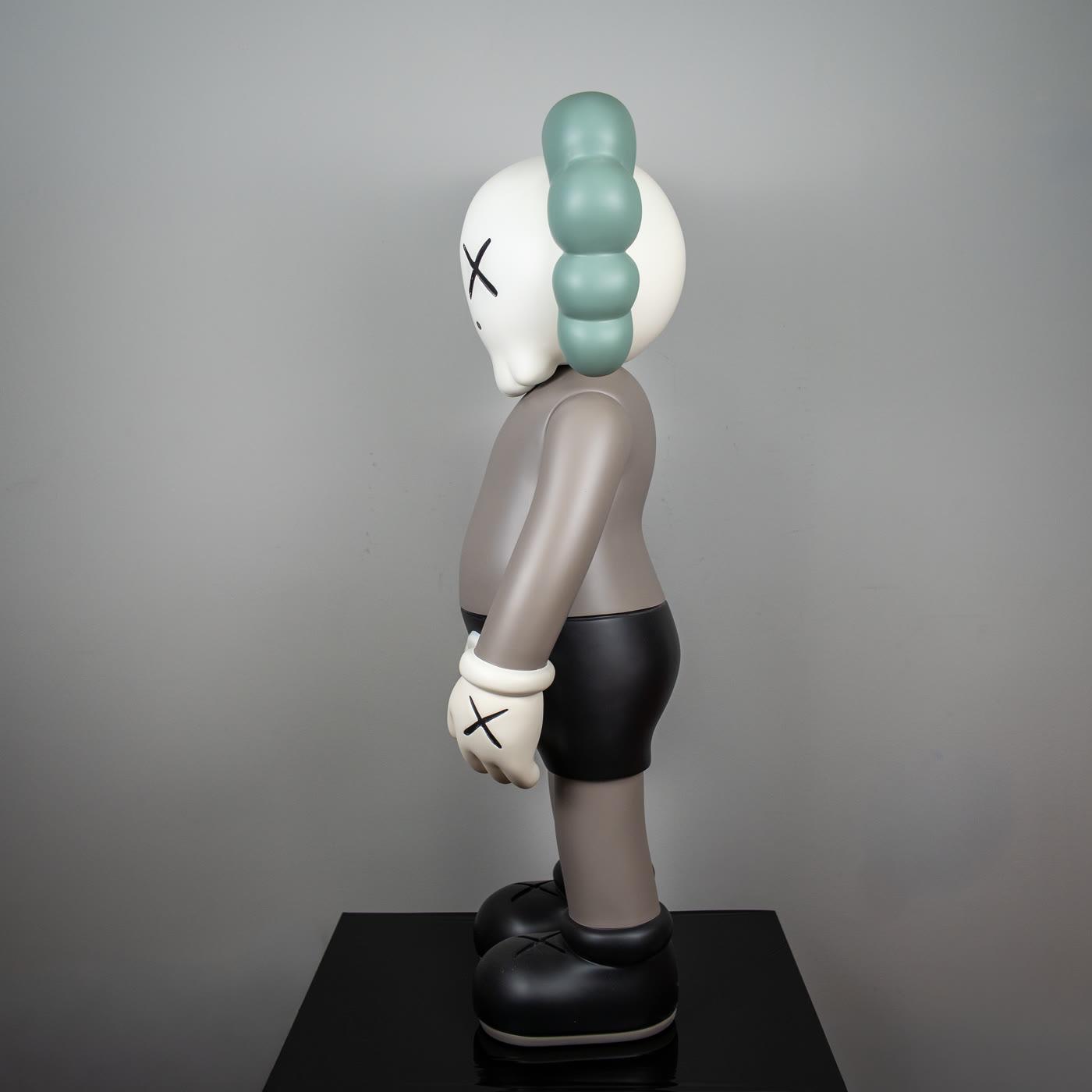
The Companion is a recurring character, not the private name of one cast. The same head, the same gloves, the same shorts and boots return in different poses. Standing, the figure is open: the face is forward, the arms sit with the body, and the X eyes flatten expression into a sign. A closer reading lives in the Companion essay. What matters here is simpler. When people say KAWS, they are usually picturing a character design stable enough to survive both a painting and a sculpture. It is a body you can recognise from across a room.
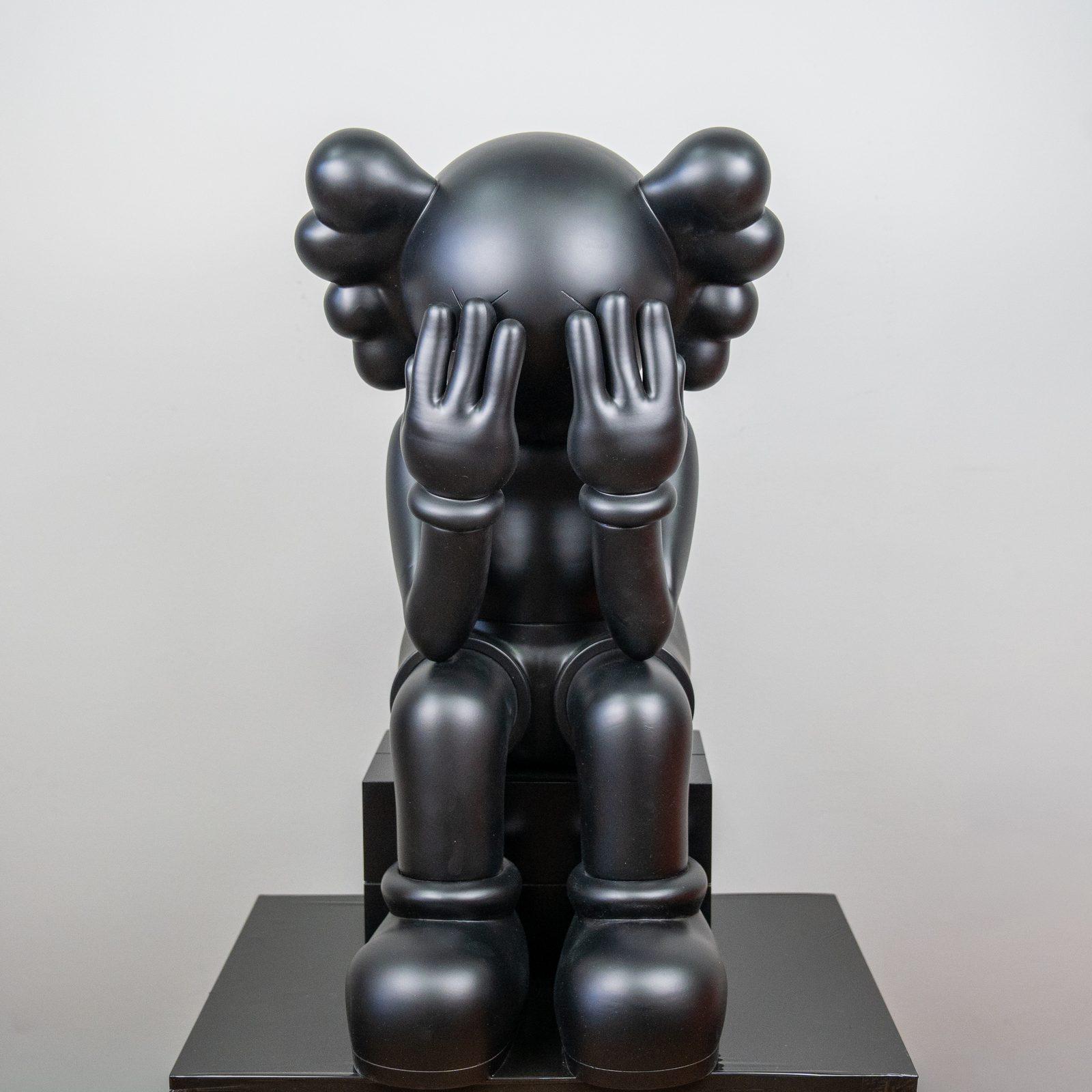
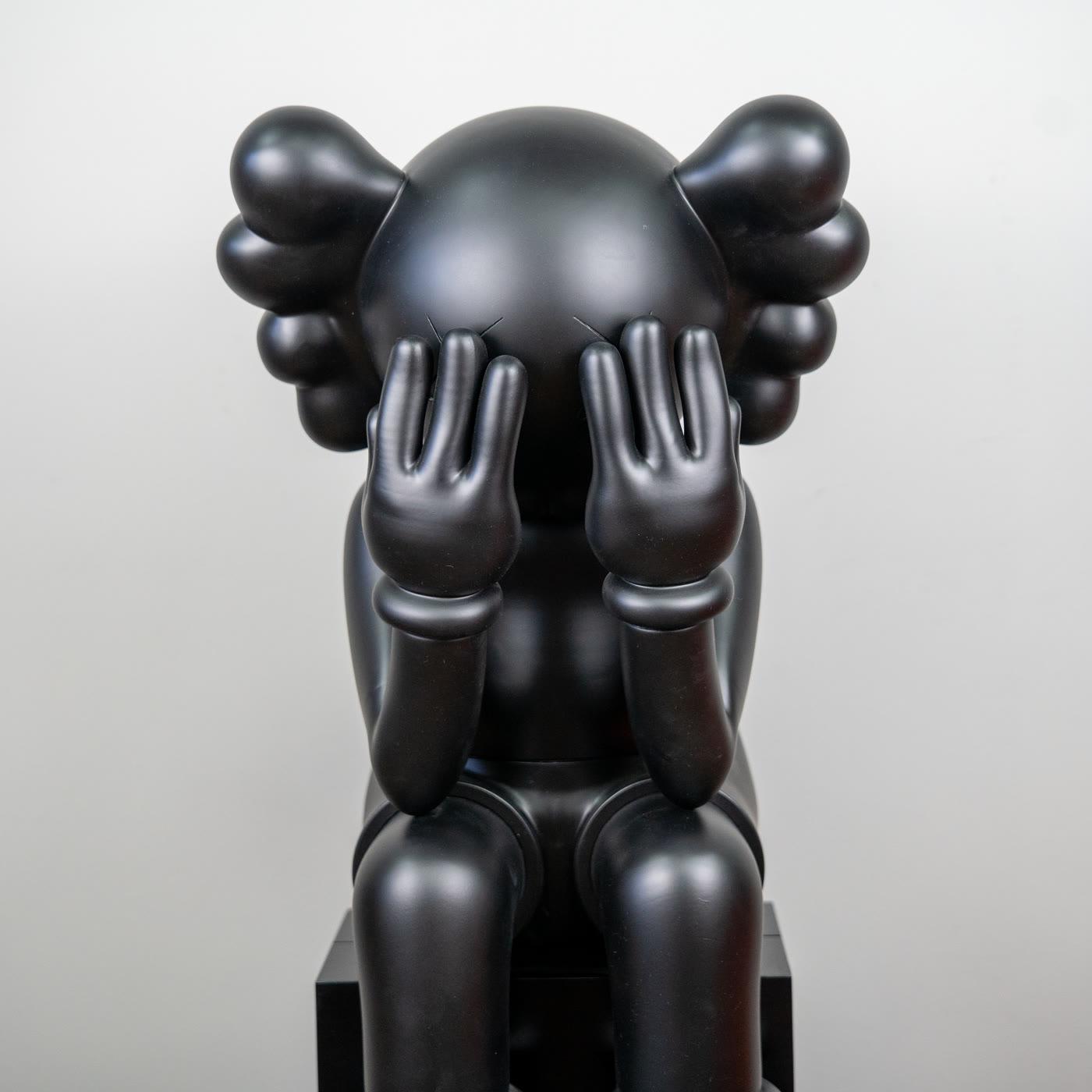
Passing Through is a known pose of that same character. The figure sits, and the hands cover the face. The name describes the pose. It is not a quotation. Viewers often find a pause, a withdrawal, or a quiet in that closure, and those are readings the pose allows. They are not a sentence to be pinned on the artist. Seeing the standing figure and the seated pose together shows two tempos of one language. One meets the room. The other covers its face. Both are KAWS.
Painting, sculpture, and circulation
The work does not sit in one material. Painting, sculpture, and widely seen commercial collaborations carry the same character at different speeds. A painting stays on the wall. A sculpture asks you to walk around it. A collaboration takes the character into shops, clothing, and screens. This essay will not invent a year-by-year list of partnerships. What is visible is enough. The character left the studio's immediate circle and became one of the faces popular culture already knows. That circulation does not replace the painting or the sculpture. It adds another ring of viewers beside them.
This is why KAWS is often discussed near the art of popular images. What pop art is remains a separate question. Pressing a 1960s method onto a later character language is haste. The shared ground is an interest in images that already circulate. The difference is generation, tool, and temperament. KAWS does not arrive as a pop art manifesto. A viewer can still see cartoon simplification, repeated colour, and the weight of sculpture under one name. Comparison helps. Equivalence thins the name. The calmer path is to leave each history where it stands.
Locking the meaning too early
As the name grows, ready-made sentences stick to it. One treats KAWS as only a toy brand. Figures brought the character into collecting culture; the character was not born as a shop department. Another pins the X eye to a single slogan. Critics and viewers have read the X as erasure, as the cartoon convention of closed or crossed eyes, and as a way of flattening expression into a sign. Those are readings, not a motto the artist certified. A third mistake quotes Passing Through as if it were a confession. The title names the pose: seated, hands over the face.
A fourth confusion sits closer to this catalogue. The figures at Popüler Sanat are finished collection objects that carry this silhouette and this pose. We do not present them as original sculptures, licensed editions, or an authorised sale of the studio. The distinction keeps the looking honest. A piece at home brings the character language into a room. The artist's own production record lives elsewhere. A collector who can hold both sentences neither inflates the object nor dismisses it as a casual ornament. The piece does its work in the room that was chosen for it.
Park, museum, and room
In a sculpture park you walk around the figure. Sky becomes the backdrop, steps set the scale, and the head tips back. In a living room the same character stands before a console, a niche, or a quiet wall. These are not copies of each other at different sizes. A park does not need to be rebuilt in a salon. What works at home is a silhouette that reads clearly, with a margin of air around it. A busy poster wall, a shelf of small objects, and a hard ceiling light all compete with a face that was designed to be simple. A calm ground works in the figure's favour.
A museum visit is not required. The character is clear enough to recognise in a photograph. In a room, light and distance either keep that clarity or spend it. A matte surface deepens under soft light. A glossy surface mirrors the room. Both are right, and they ask for different rooms. Trying to imitate a large public work at home makes the figure feel smaller. Leaving it at a comfortable height, at a distance the eye can settle, is enough. Scale here is not a centimetre claim. It is whether the gaze can reach the figure without strain.
How to look at a figure in the catalogue
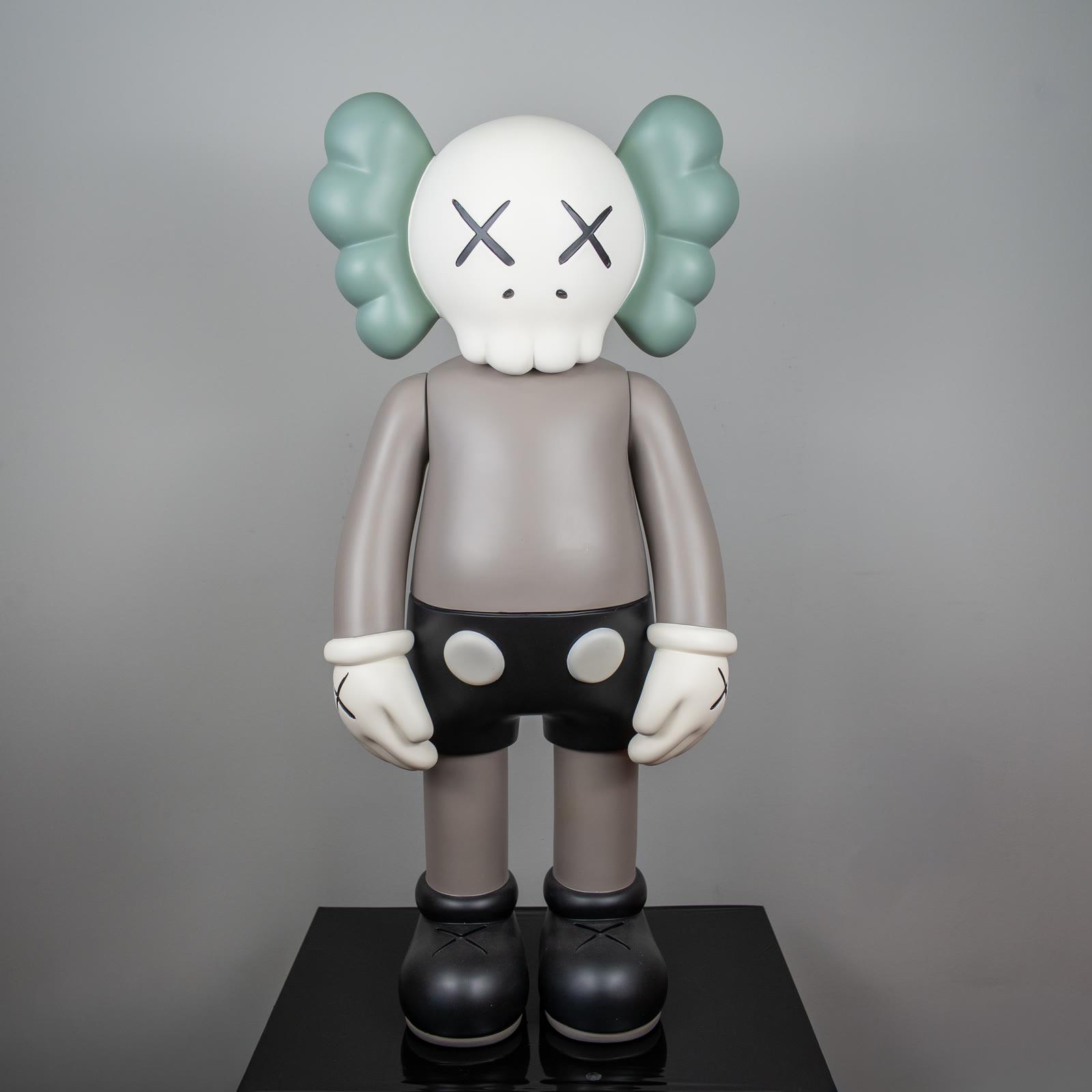
The Sage Companion carries the standing silhouette with sage ears, a taupe body, black shorts, white gloves marked with X, and black boots. The colour separates without shouting. The ears lean green, the body stays in a warm grey-beige, and the shorts and boots darken. It is a legible entrance for a room meeting the character for the first time. The face is open, the stance is upright, and the parts do not blur. Placed alone on a plain ground, the small difference between sage and taupe becomes visible. A second object can wait until that difference has settled.
The matte black Passing Through turns the same language into the seated pose. The hands cover the face, the surface is matte and single-tone, and the silhouette comes forward under light close to a gallery. The standing figure greets the room. The seated figure slows it. Buying both is not a requirement. A talkative room often suits the covered face; a room that is already quiet often suits the standing Companion as a clearer welcome. The selection sits on the KAWS page and within the wider collection. Availability can wait. The first question is which pose belongs to the room.
After the name, the looking
Knowing KAWS is not a matter of memorising a long biography. The city, the start in graffiti, and the Companion's steady anatomy put the name in place. The rest is looking. The roundness of the head, the X at the eye, the closure of the glove, and the weight of the boot complete the character when they arrive together. If a piece carries that language cleanly, the reason it stands in a room becomes clear. What is missing is rarely a slogan. What is missing is a wall calm enough for the figure to approach.
From here, the character continues in the Companion, and the street continues in the context of the beginning. The neighbourliness with pop art is another door, and it should not be rushed into sameness. When the name stays in its place, the figure does too. The work of this page is to clarify the looking, without inflating the name and without telling the catalogue piece larger than it is. The rest belongs to the light in the room.