A recurring character
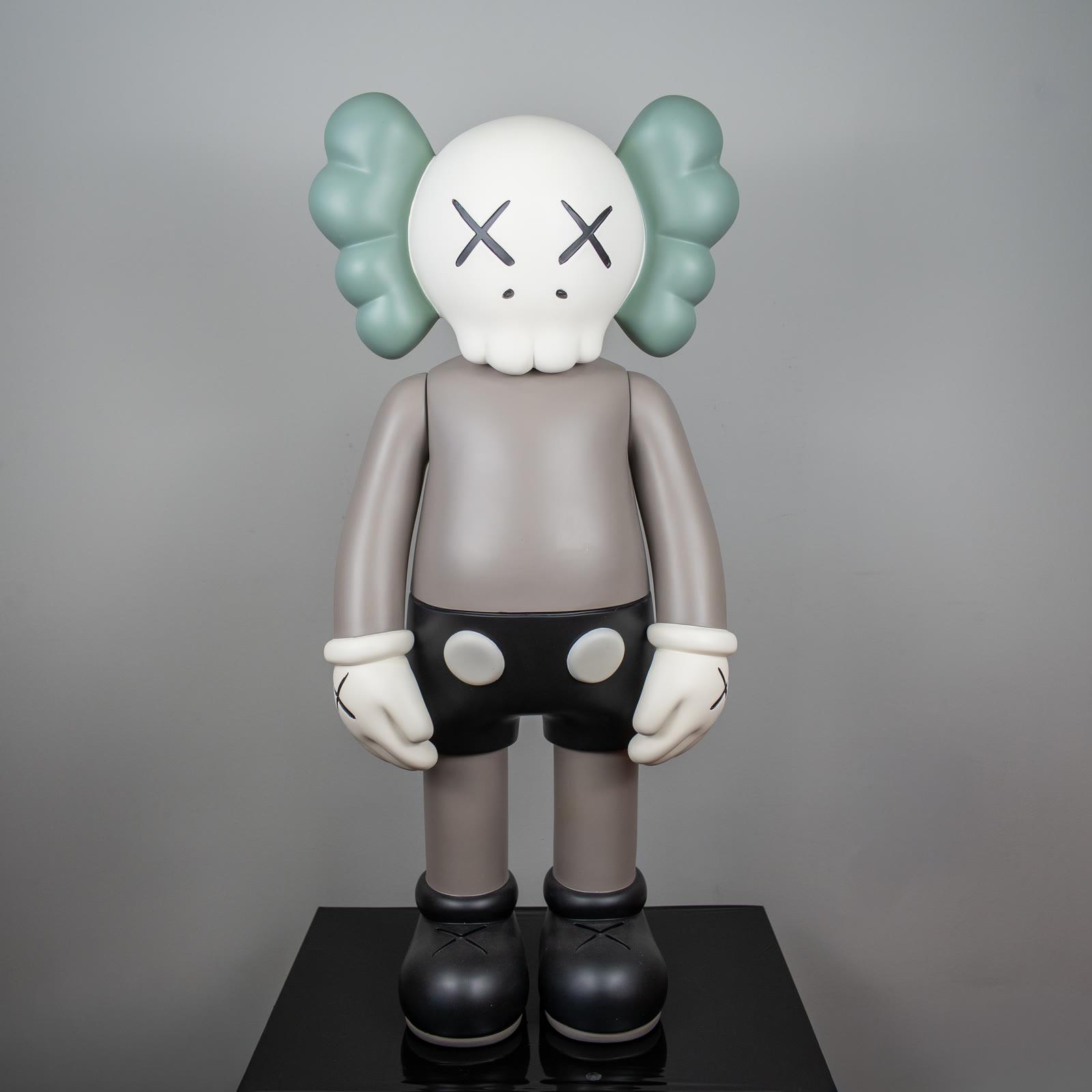
The Companion is the recurring character of Brian Donnelly, the artist who works as KAWS. A rounded, skull-like head, X-shaped eyes, gloved hands, shorts, and boots make the figure recognisable even from across a room. It is not the private name of one sculpture. The same body returns in painting, in sculpture, and in widely seen commercial collaborations. The name stays. Pose, colour, and scale change. To understand the character is to see that fixed anatomy before memorising a label on a single object.
Who KAWS is belongs to another essay. Donnelly was born in Jersey City in 1974 and started in graffiti. That entrance is kept in the essay on the name. The question here is narrower. Why does the Companion stay in mind so quickly? Because the face is simplified, the hands close like part of a costume, and the body carries the legibility of a cartoon together with the weight of sculpture. It is recognised as fast as a mascot, and it does not sit as lightly as one. That double life explains the character's place.
Head, gloves, shorts, and boots
The head is the character's first sentence. It approaches a skull without giving an anatomy lesson. Roundness softens the eye socket and the jaw, so the figure is both grave and as plain as a cartoon. The eyes are X-shaped. The mark has no single official meaning. Critics and viewers have read it as erasure, as the cartoon convention of closed or crossed eyes, and as a way of flattening expression into a sign. Those readings are separated in the essay on the X. In the anatomy, what matters is that the X takes the place of brow, lash, and glance. The face does not narrate feeling in detail. It turns feeling into a sign.
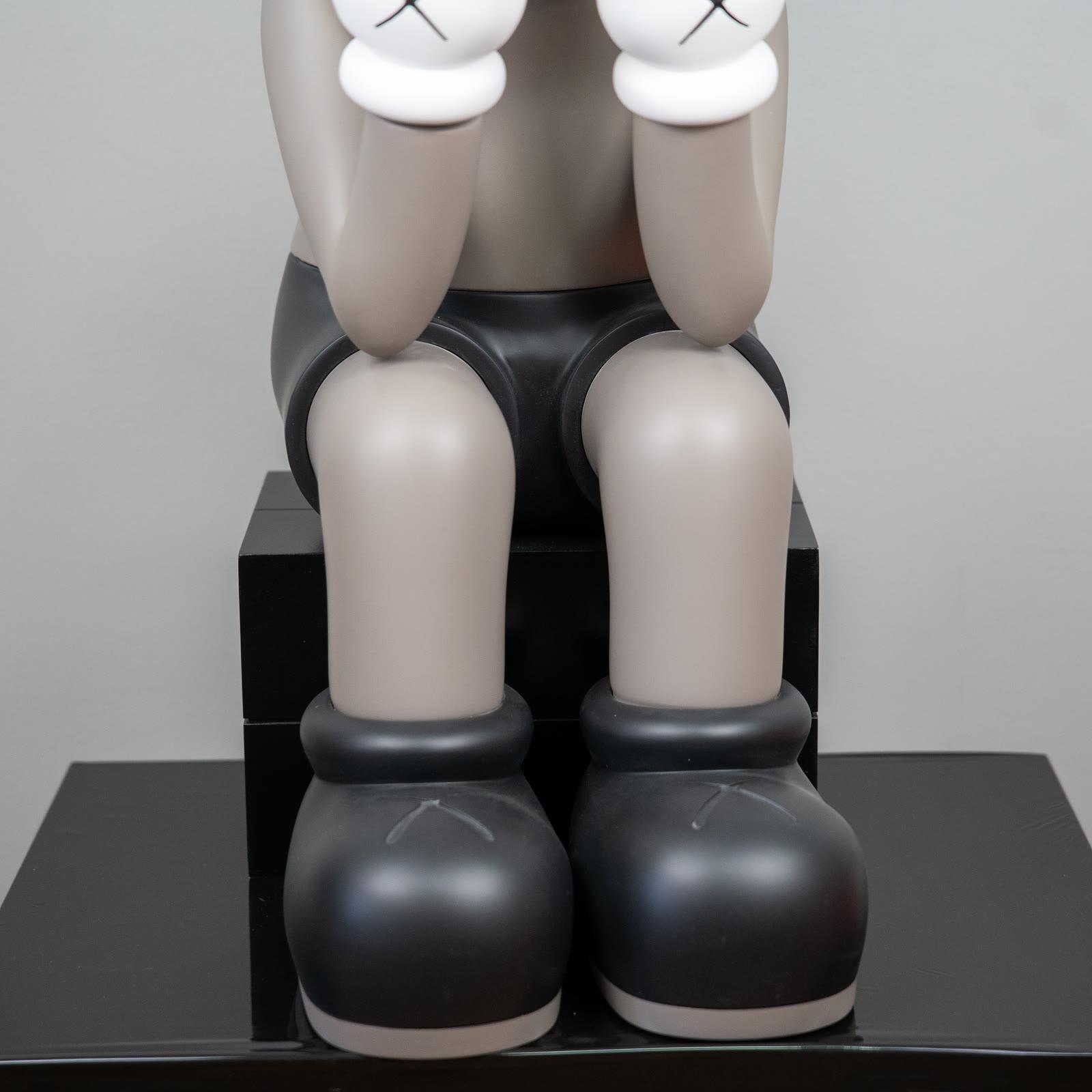
The hands are gloved, and an X is often repeated on the glove itself. The palm does not open like a bare hand. The costume closes, and the gesture simplifies. Shorts and boots tie the body to a character. This is not a nude sculptural torso. Clothing brings the figure near the outfit of an everyday hero or a cartoon, then holds that outfit at the seriousness of sculpture. Four parts complete the Companion: head, hands, shorts, boots. If one is missing, a familiar silhouette may remain, and the language stays unfinished. The design's conviction is exactly this repetition.
The standing pose
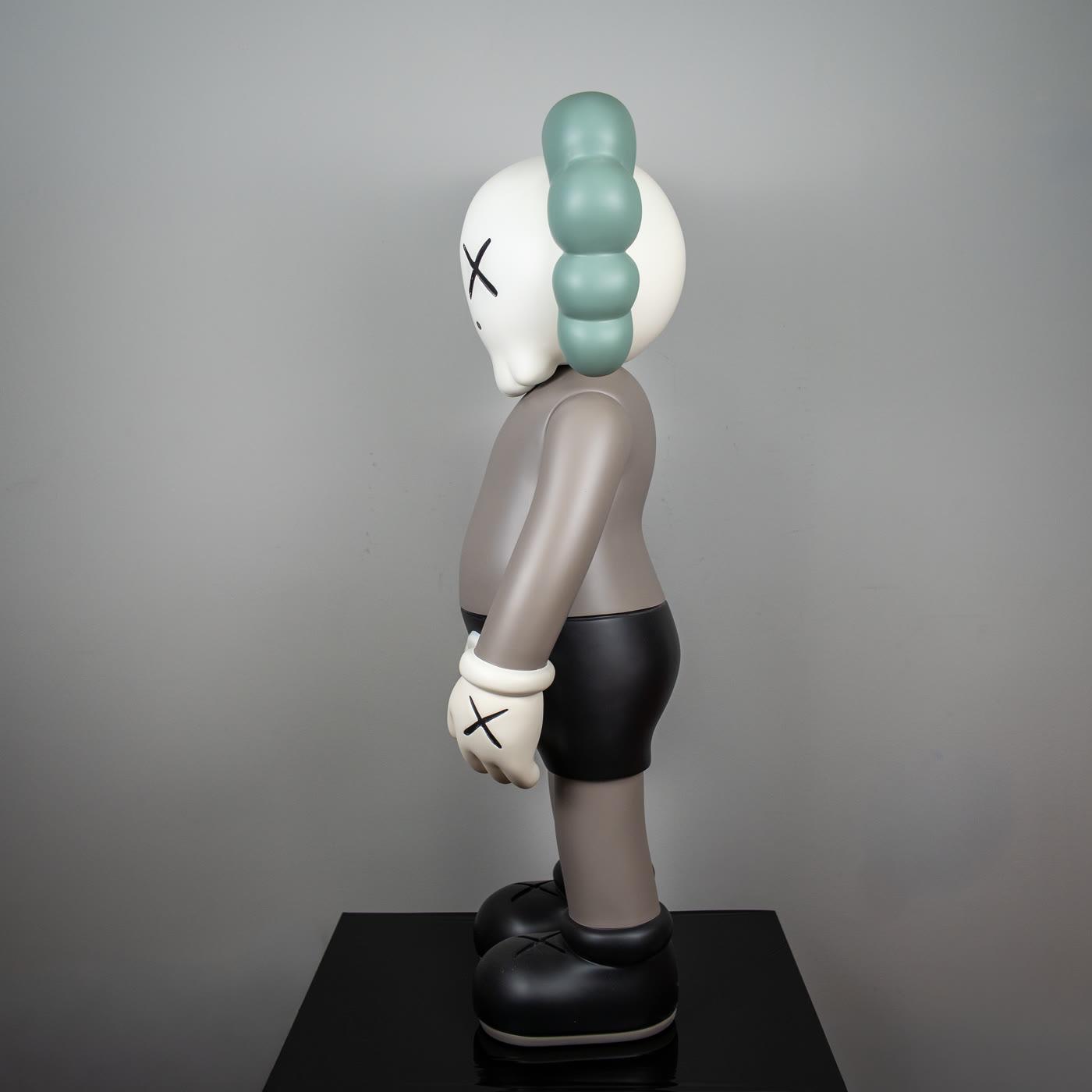
Standing, the Companion is the open version of the character. The face is forward, the shoulders do not drop, and the arms stay with the body. The gesture is large and it does not shout. The figure neither attacks nor flees. That calm uprightness separates it from an action figure. A superhero is designed for a punch. The Companion is designed for a stance. Entering a room, you read the roundness of the head first, then the mark at the eye, then the weight of the boot on the floor. The order runs that way because the character is built like a sign system from top to bottom.
Colour does not change the anatomy. Sage ears and a black body are the same character. Colour chooses the room and the light. A matte surface softens the line. A glossy surface lays the room onto the figure. The same Companion can feel warm in a hall and more graphic in a studio. Liking the character and liking a colour are two decisions. Look first at whether the silhouette belongs to you. Colour comes after that silhouette has settled. A rushed colour can feel like the wrong character, when only the tone has changed.
Passing Through is a pose
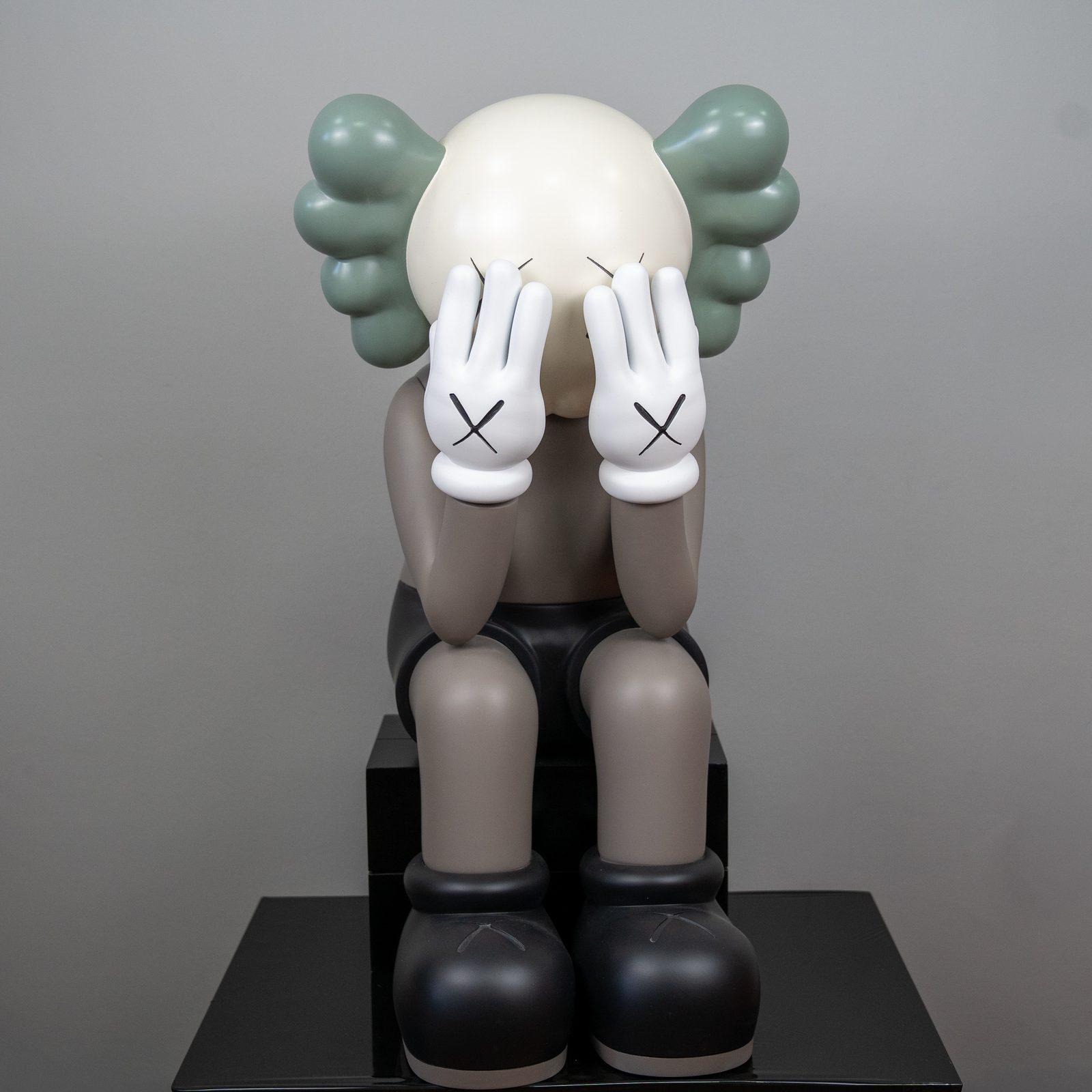
Passing Through is a known pose of the Companion. The figure sits, and the hands cover the face. The name describes that posture. It is not circulated as a sentence taken from the artist, and it is not an official explanation of one emotion. When the hands reach the face, the X eyes close over, the mouth disappears, and the character hides its own sign for a moment. A viewer may find a pause, a withdrawal, or a tiredness there. That looking is welcome. It does not need to become a slogan placed in the artist's mouth.
The standing figure meets the room. The seated figure slows it. Both are the Companion. A change of pose is not a change of person. It is another time of the same body. The distinction becomes clear when two pieces sit near each other in a collection. One is a greeting. The other is a silence. Choosing the one the room needs is a way of understanding the character. Owning both is not a test of completeness. One right gesture is more honest than a crowded shelf.
Readings that go wrong
The first mistake is to treat the Companion as the name of one manufactured object. The character repeats. The second is to count every figure as an original studio sculpture. KAWS's own work lives in museums, parks, and the artist's record. The pieces in the Popüler Sanat catalogue are finished collection objects that carry this silhouette and this pose. We do not present them as licensed editions or as an authorised sale. The third mistake is to lock the X to one meaning. The mark is strong because it stays open to more than one reading. Reducing it to a motto spoils the simplification of the face.
The fourth mistake is to make the character only a symbol of sadness. A covered face can invite that reading. The same body can also stand upright, in colour, almost gently. Feeling is a result built by pose and colour together. It is not a diagnosis written on a birth certificate. The fifth mistake is to treat the clothing as minor. Without shorts and boots the figure drifts toward another sculpture. The costume binds the Companion to a body popular culture already knows. The seriousness comes from the same place: a familiar outfit, on a face we do not already know.
Sage standing, taupe seated
The Sage Companion shows the standing character with sage ears, a taupe body, black shorts, white gloves marked with X, and black boots. Ear and body sit close to each other. There is no shouting contrast. That closeness keeps the figure legible in front of a quiet wall. The white glove breathes between the dark shorts and the boots. The X repeats at the eye and on the hand. Someone seeing the piece for the first time can take the character's grammar in one look. For that reason the sage tone is an unforced way into a collection.
The taupe Passing Through carries the same family into the seated pose. The figure sits, the hands cover the face, and the body stays in a warm taupe. Because the colour does not shout, the gesture comes forward. The two pieces can be thought of together: one opens the face, the other covers it, and the palette does not scatter. A small room needs only one pose. A room gathered around a seating group often takes the seated figure more easily into its tempo. The selection sits on the KAWS page. We make no claim in centimetres. The decision follows the relationship between the silhouette and the air in the room.
Leaving the character in the room
Bringing a Companion home is not the same as building a biography exhibition. The roundness of the head, the quiet repeat of the X, and the boot meeting the floor are a sufficient sentence. That sentence is readable when a little air remains around the figure. A crowded shelf turns the character into an accessory. A plain ground shows it as sculpture again. Soft light deepens a matte surface. A hard ceiling light can drop the shadow like a brow and start an argument with the sign. The practical rule is plain. The figure should stand alone enough not to lose its own face.
The character language continues in how to read it, and the mark at the eye continues in the essay on the X. The context of the name stays where it is. This page was written to describe the Companion without inflating it. A figure at Popüler Sanat carries that description into a room. It does not stand in for the artist's own sculpture. When the distinction is kept, the piece relaxes. A relaxed piece stays right in the room for longer. The looking stays at the same calm.