

How a character language is read
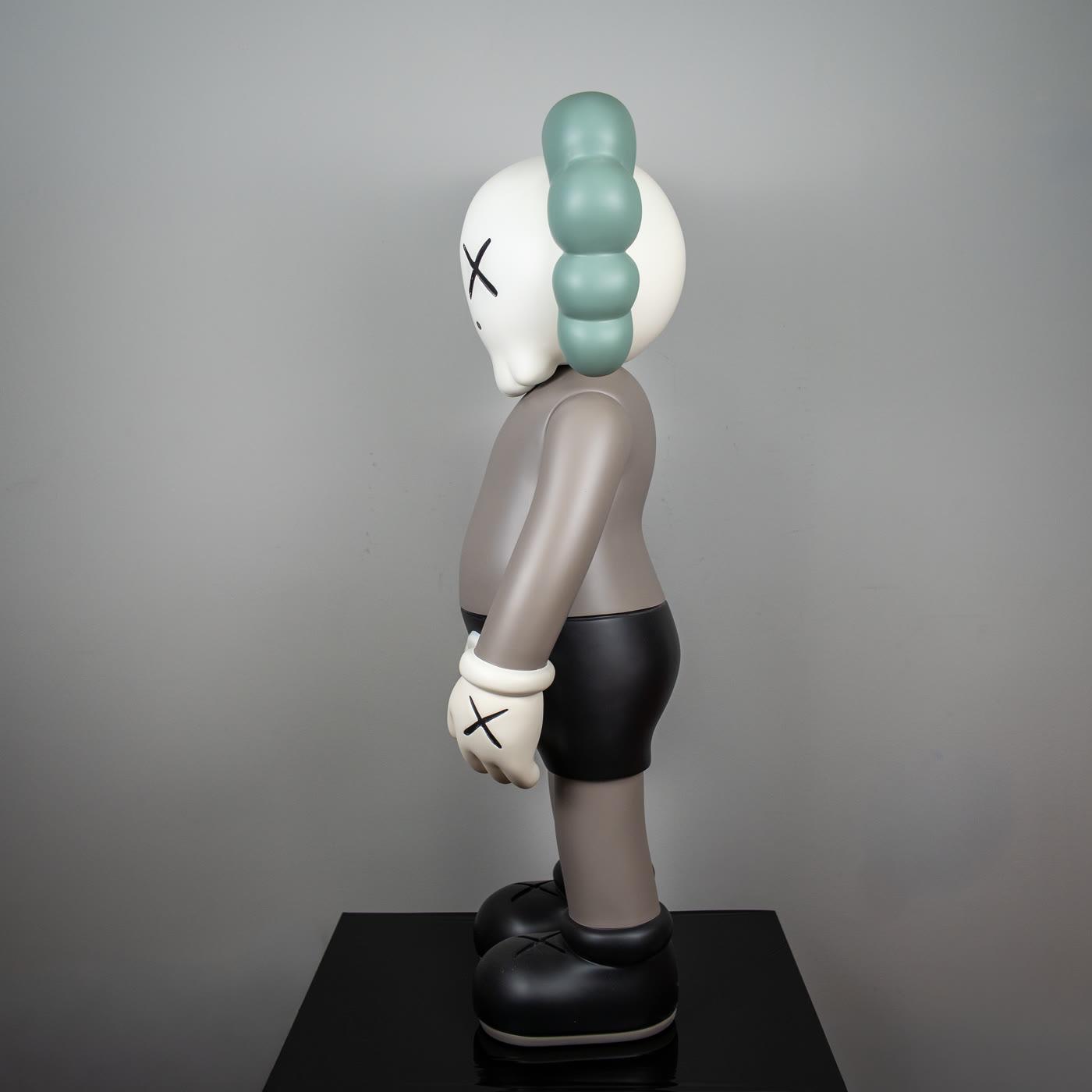
The KAWS character language is the grammar of a repeating body. The Companion is its most widely seen sentence: a rounded, skull-like head, X-shaped eyes, gloved hands, shorts, and boots. Reading the language is not a rush to name the figure's emotion. It is seeing which parts stay still and which parts move with the pose. The shape of the head stays. The mark of the eye stays. The glove stays. Sitting or standing bends the sentence. It does not erase the words.
Brian Donnelly carried this language under the name KAWS, out of a practice that started in graffiti. The name and the city have another door. The looking here stays close to how the character is built. A good character language gives a silhouette from far away and a system from close up. The Companion gives both. Three steps back, the roundness of the head is enough. One step closer, the mark on the glove, the edge of the shorts, and the weight of the boot come into play. The reading is finished between those two distances. Falling for one detail and forgetting the body leaves the language half done.
The head and the mark at the eye
The head is the character's logo, and it is not flat like an emblem. It has volume. Approaching a skull pulls the figure somewhere more serious than a charming circle. The same roundness also keeps it from becoming an object of fear. The result is an interval that holds the gaze. Neither a full skeleton nor a full toy. That interval is the design decision of a KAWS face. Reducing it to one word closes the interval. The face stays in mind precisely because it is not settled.
The X takes on the work of brow, glance, and mouth. It has no single official meaning. Critics and viewers have read the mark as erasure, as the cartoon convention of closed or crossed eyes, and as a way of flattening expression into a sign. The detail lives in the essay on the X. Inside the language, the job of the X is plainer: it binds feeling to a character instead of multiplying feeling. When the same mark repeats on the hand, face and hand speak one sentence. That repeat is the signature of the design. It is not a random ornament.
Glove, shorts, and boots
The glove takes the hand out of a fine gesture and binds it to a costume. The fingers do not tell a story one by one. The palm closes, the wrist ends, and sometimes the X appears again. That simplification keeps the character legible in sculpture too. A delicate anatomy falls apart from across a room. A closed glove remains a hand from across a room. The shorts divide the body and turn the figure into a dressed character. The boots bring the weight down to the floor. Together, the three take the Companion out of being a nude form. An outfit popular culture knows is worn at the seriousness of sculpture.
Colour can separate these parts or join them. A white glove, black shorts, and black boots set a clear rhythm on a sage or taupe body. On a single-colour figure the same parts dissolve into the silhouette, and the language is read from the outline. Both are valid. Broken colour teaches the grammar. A single tone speaks to an eye that has already learned it. If this is your first figure, a colour in which the glove stands apart is gentler. If your eye is already inside the language, a single tone stands more like sculpture. This is not a ranking of quality. It is an order of reading.
A pose is a sentence
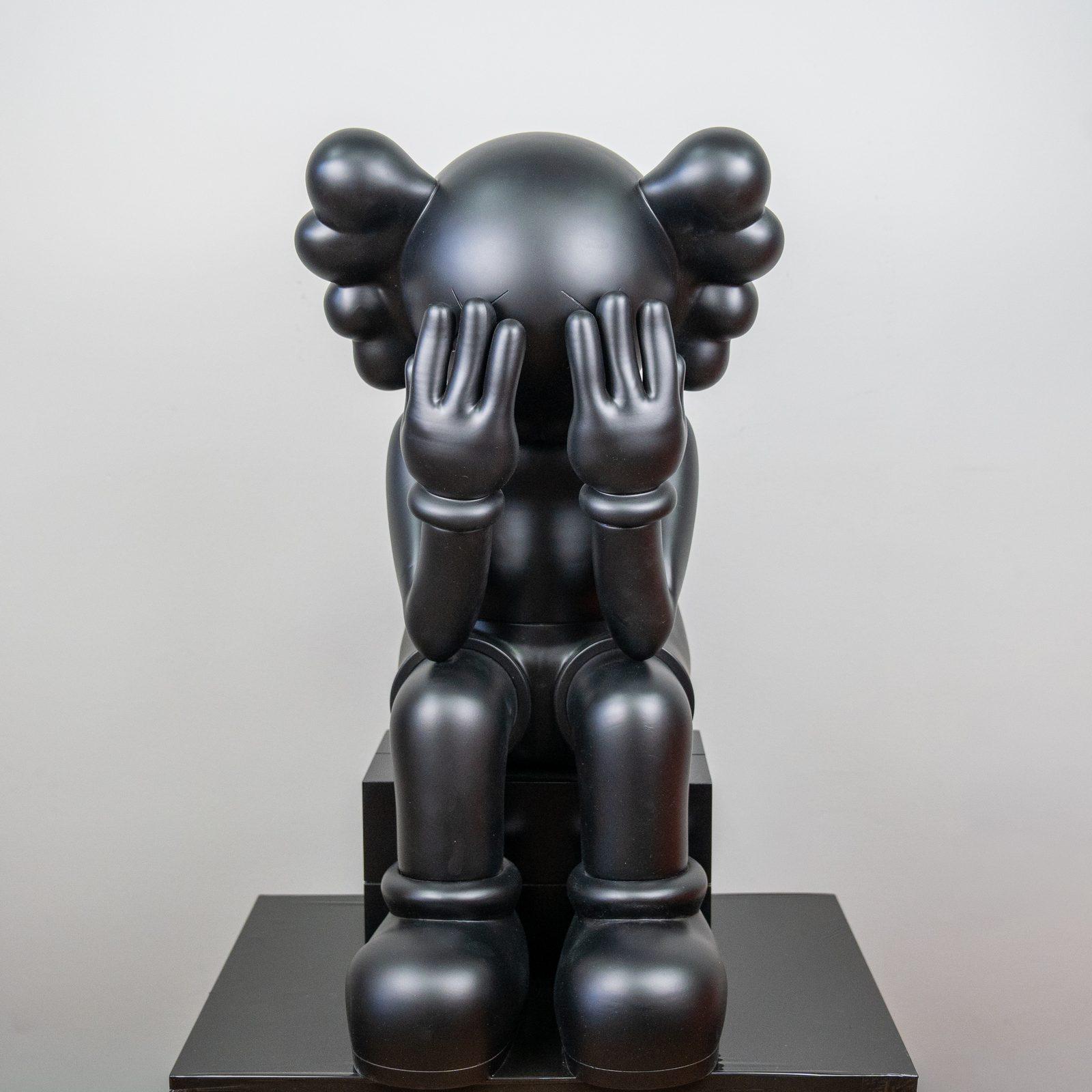
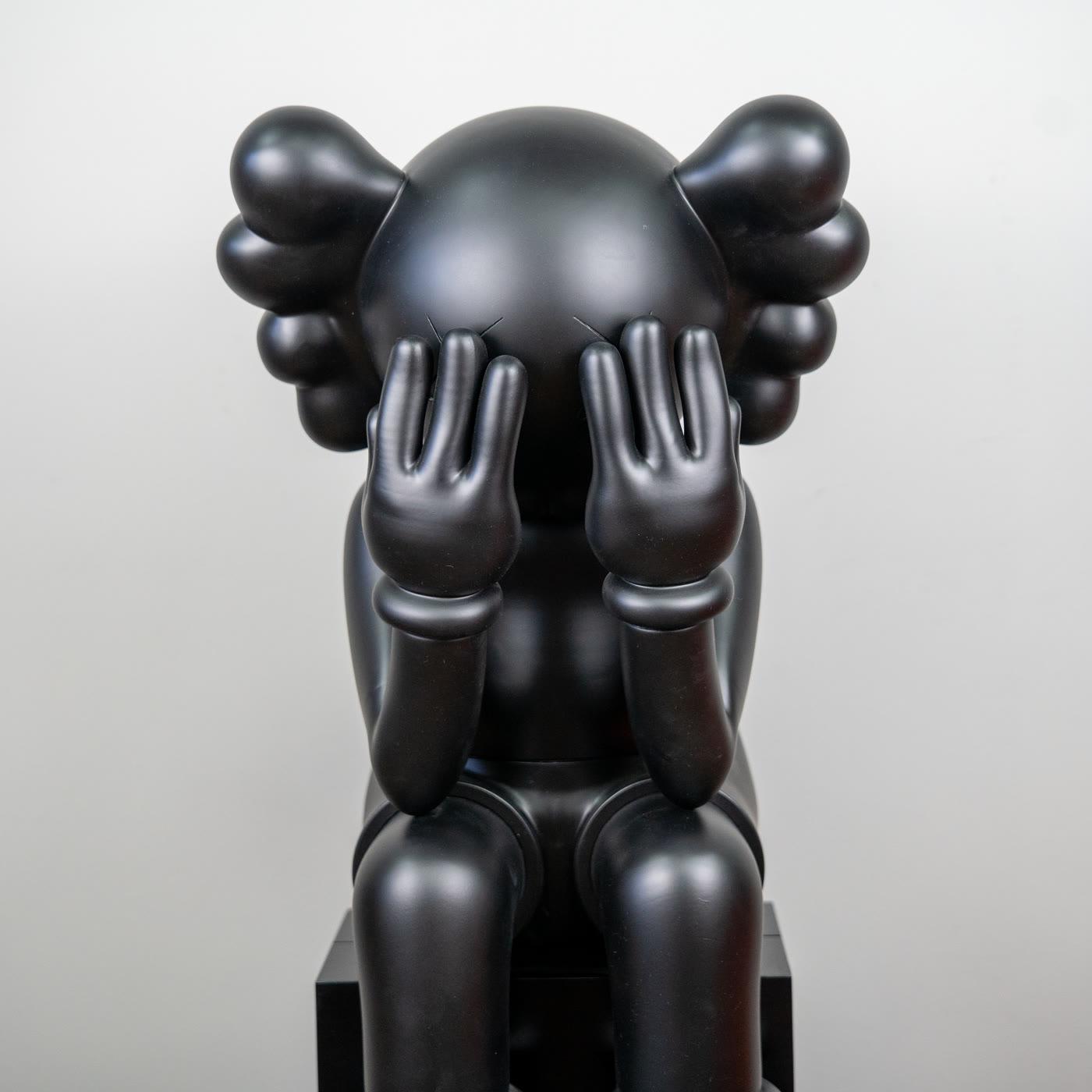
Standing is the character's open sentence. The face is visible, the arms stay with the body, and there is a greeting. Passing Through is the closed sentence of the same language. The figure sits, and the hands cover the face. This is the name of a pose, not a quotation made from the artist. When the hands reach the face, the X on the head is hidden, and the glove begins to work like another face. The sentence shortens. Feeling can increase, because the viewer completes the missing information. Completing it is a right. Declaring it the one correct emotion is unnecessary.
When you read the character language, do not confuse pose with personality. The seated figure is not a sadder someone else. It is another time of the same Companion. The Companion essay describes this body part by part. What is added here is that the description is a system. Once you see the system, a new colour does not surprise you. A new pose does not break the language. What breaks it is locking the figure to a single poster emotion. The language works where that lock is absent.
Sage as an open sentence, black as a closed one
The Sage Companion spells the open sentence in colour. Sage ears, a taupe body, black shorts, white gloves marked with X, and black boots. The parts separate, so the system can be learned at first look. Ear and body are close in tone. They do not shout. The glove is apart on purpose. The X at the eye and the X on the hand repeat the same mark at two heights. Set on a plain ground, the grammar does not scatter. It is a clean lesson for anyone bringing the language into a room for the first time, without the manner of a lesson.
The matte black Passing Through holds the same grammar in one tone and a closed pose. The figure sits, the hands cover the face, and the surface is matte black. Colour does not separate the parts. The silhouette does. When light comes from the side, the roundness of the head, the mass of the glove, and the seat of the boot become visible again. A light piece teaches the language. A dark piece hides the learned language like a shadow. You do not need both. Does your room want to teach, or to fall silent? That is the question. The answer is not in centimetres. It is where the light meets the figure.
Looking without memorising
Memorising a character language is not the same as pinning a checklist to the wall. Counting four parts and moving on is not enough. After the count, you stand in front of the figure and see which part comes forward that day. Sometimes the weight of the boot speaks, sometimes the white of the glove, sometimes the closing of the face. The language is stable. The emphasis changes. That change has to do with the light in the room and with your distance on that day. A good reading notices the system, then looks comfortably enough to forget the system.
The close lives in that comfort too. The Companion was not designed to carry a slogan. It was designed to carry a body. The language stays clean when you look without locking the meaning of the X, without taking Passing Through for a confession, and without counting a catalogue piece as an original sculpture. A language that stays clean also sits cleanly at home. That cleanliness is enough when you choose among the collections. The rest is left to the figure, to finish its own sentence.