
What is a BE@RBRICK?
A BE@RBRICK is a figure produced by the Japanese company Medicom Toy, introduced in 2001. The basic form is a stylized bear built from blocks: a cylindrical torso, round ears, a simple face, and articulated block limbs. That simplicity is the point. The figure is recognizable from across a room because so little is asked of the eye.
The basic bear-shaped block figure is widely associated with the designer Tatsuhiko Akashi. The name, the form, and the maker belong together. Not every block bear in a room is part of that history. The name BE@RBRICK belongs to Medicom Toy’s figure. Bear figures in the Popüler Sanat catalog share the visual family as decorative pieces.
Spelling is part of the distinction. The mark is written BE@RBRICK, with the @ in the middle. Everyday speech often drops that and says Bearbrick, and search carries both. In this piece the proper name is reserved for the Medicom figure. A catalog piece is called a bear figure. Treating the two words as the same object blurs both the history and the shelf.
Why does the form read so quickly?
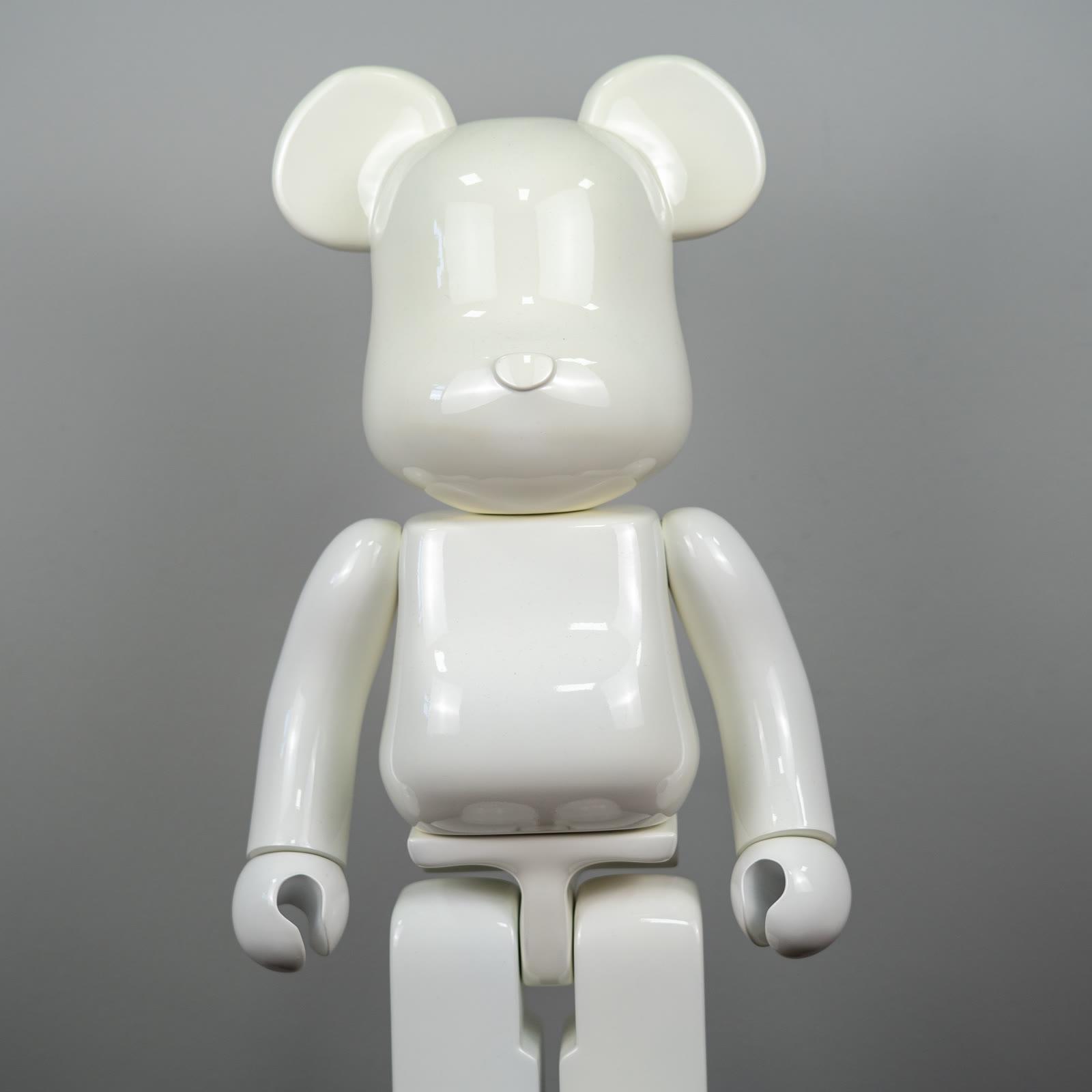
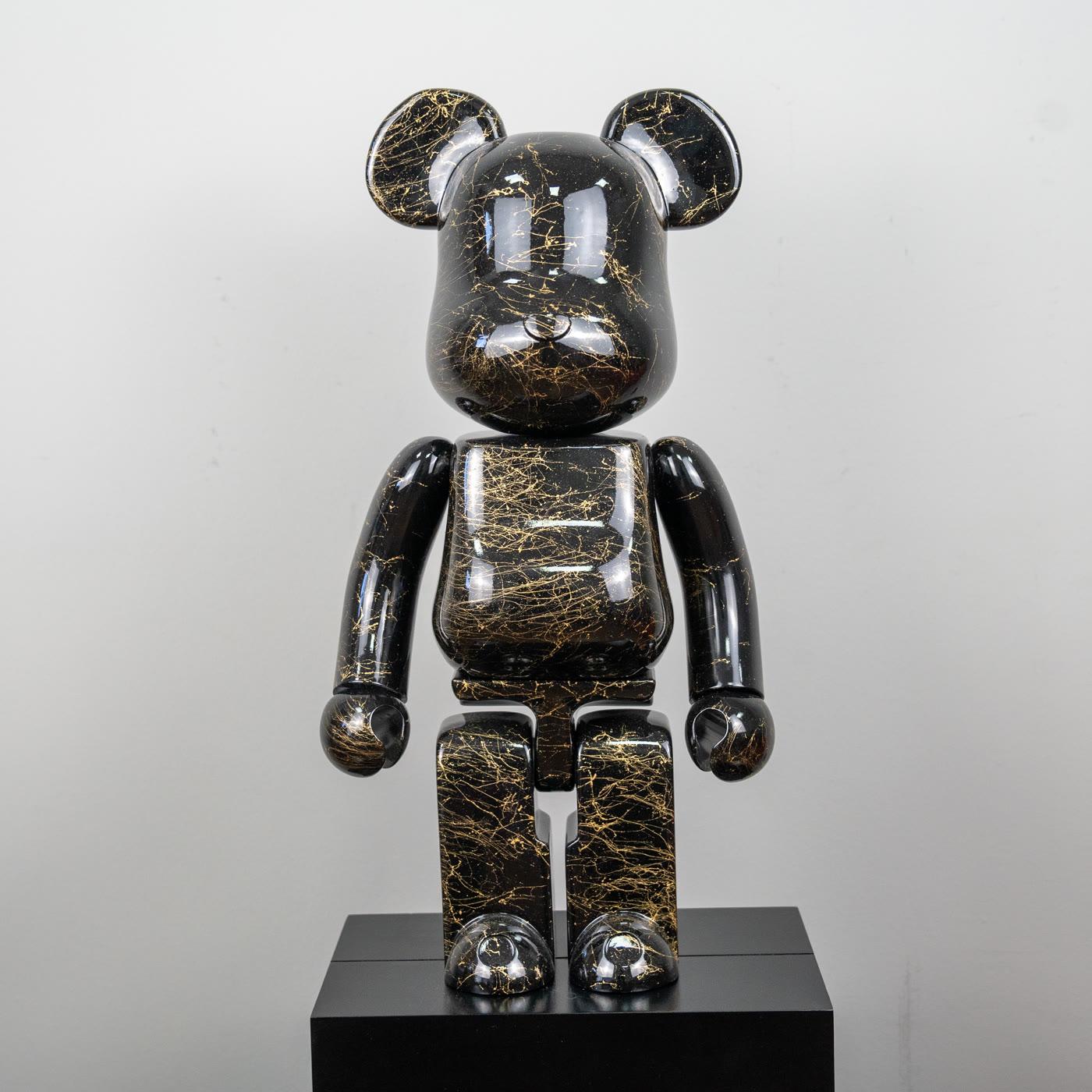
The form reads as a bear at a glance because the body is reduced to a single cylinder and the ears sit on it like two plain circles. The face does not perform. Expression comes from stance more than from detail. The arms and legs are blocks. The joints exist to leave a basic range of movement, not to turn the figure into a locked statue.
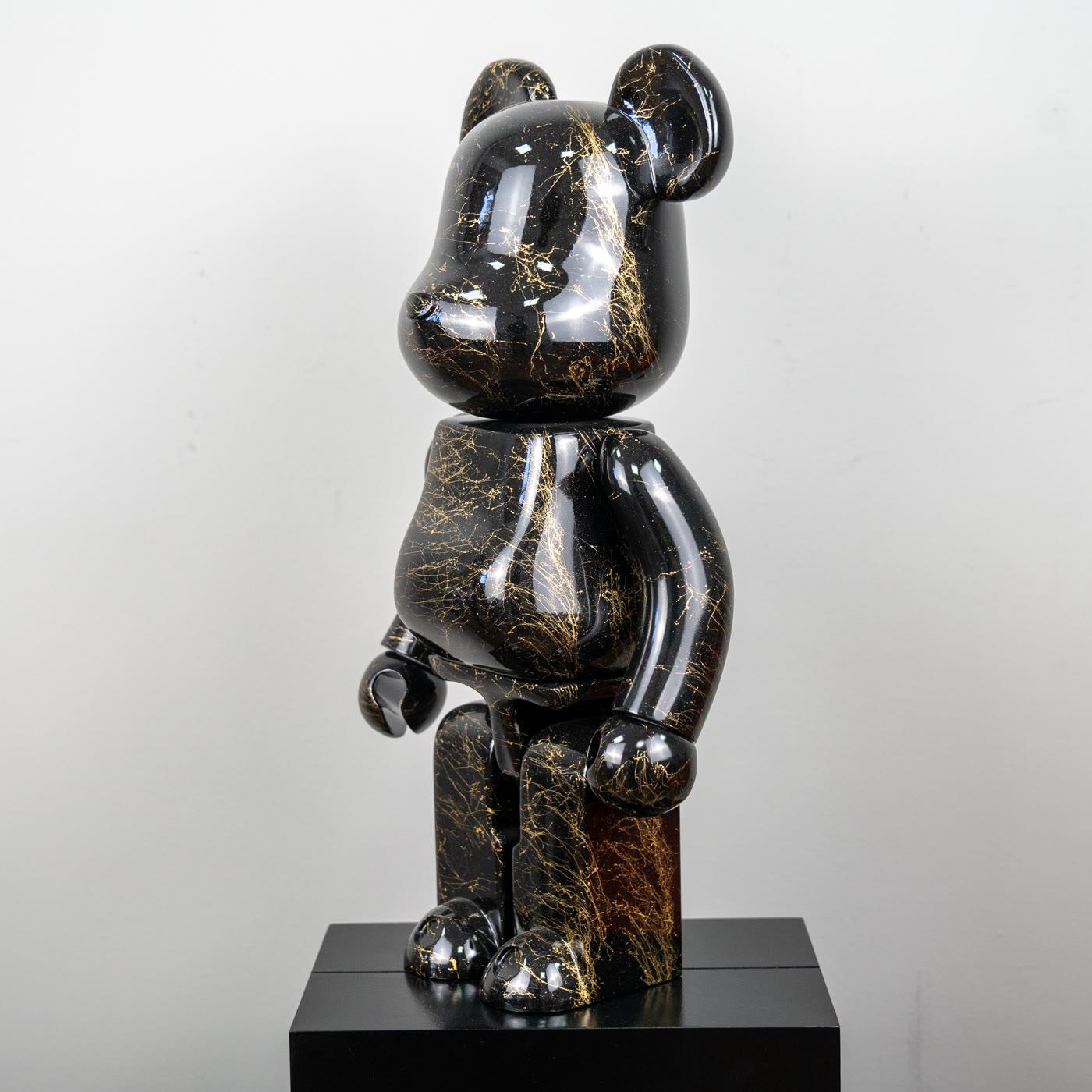
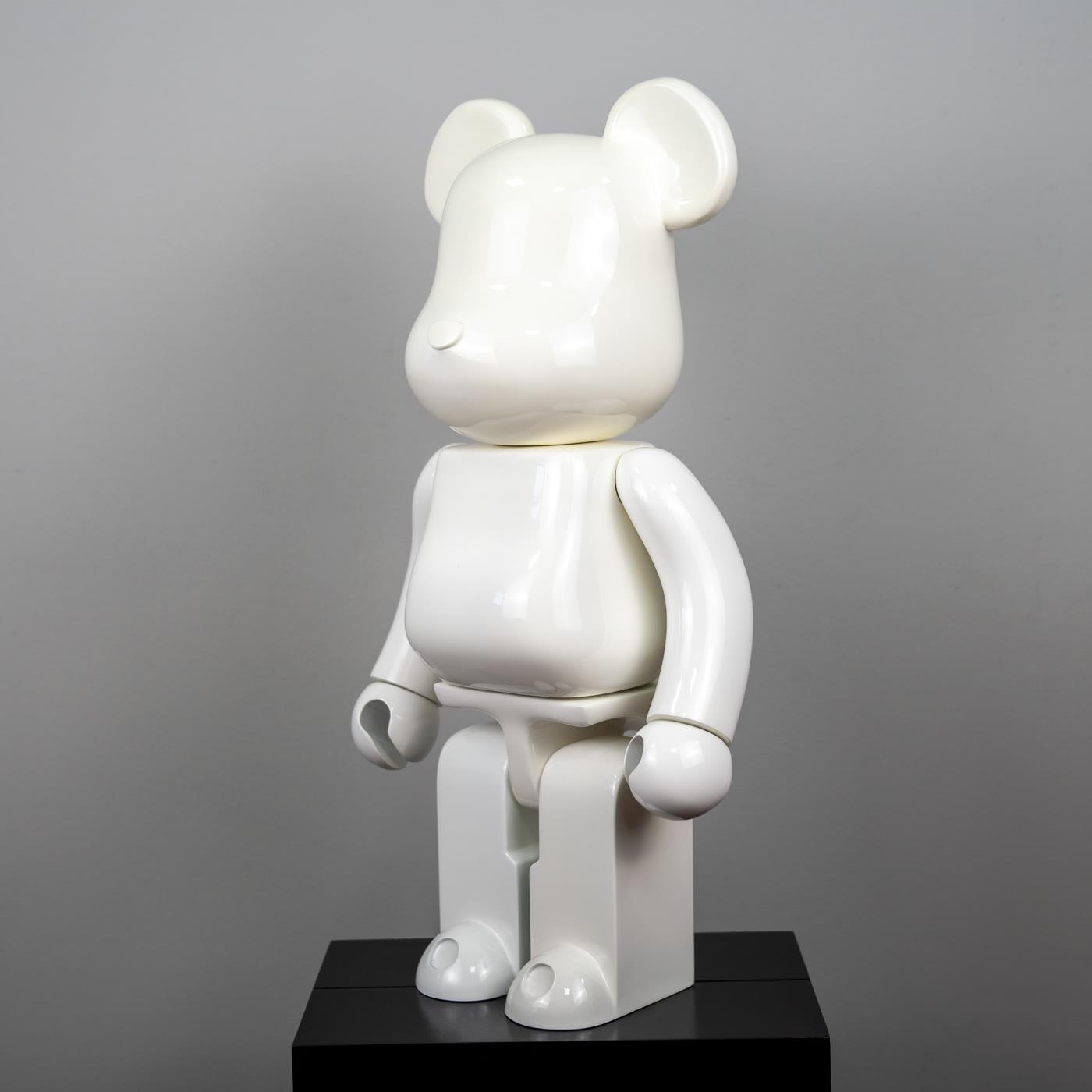
That anatomy leaves the surface open. A flat color, a gloss, or a print can arrive without breaking the silhouette. The black marble Bearbrick lets light travel across a dark mass. The glossy white bear figure holds the same mass in a bright room, close to plain sculpture. Both are catalog pieces. Their measurements are not paired with the Medicom percentages in this article.
The cylinder also decides how light falls. On a gloss finish the highlight runs as a thin line. On a matte surface the shadow reads between the joints. The two finishes are not required to be two versions of one official object. One wants reflection. The other keeps the form quiet. When you choose a room, that difference does more work than the name.
When was it introduced, and by whom?
The figure was introduced in 2001 by Medicom Toy. The company is known for Japanese toy and collectible production, and BE@RBRICK became one of the most widely recognized forms in that line. Akashi’s name points to the design of a repeatable industrial form, rather than to a single signed sculpture.
Repetition here is not a loss of care. Because the same body can be rebuilt with a different surface, a collecting language grew around it. Fashion, music, and art used the body for their own images. The pace of that story sits in how the culture formed. The manufacturer’s site, without an invented page title, is https://www.medicomtoy.co.jp/
The date does not, by itself, make a piece precious. 2001 is a starting year. A block bear made after that year is not automatically a continuation of that start. Place of production, series, and surface are separate questions. When they collapse into one another, the figure becomes a more closed object than it is.
What does a percentage size actually say?
The percentage is the name of Medicom’s own size system. It is not a universal ruler for every bear figure. In the published correspondences, 100% is 70 mm, 400% is 280 mm, and 1000% is 700 mm. Other percentages exist in the system. This article does not invent millimetres for the in-between sizes. The current figure belongs on the manufacturer’s chart.
Those numbers are not the measurements of Popüler Sanat photographs. A bear on a screen might fit in the hand, or it might approach the scale of furniture. A photograph hides millimetres. Measuring the place where it will stand is a steadier step than memorizing a percentage. The detail opens in the size system.
Which misconceptions throw the decision off?
The most common misconception is to see a block-bear silhouette and treat the piece as Medicom’s BE@RBRICK. The silhouette is a clue, not an identity paper. The second is to treat a foot logo, a box, or a hologram as enough on its own. One of those marks, alone, does not prove what a piece is. The maker’s records and current account are what count.
The third misconception is that a larger figure is the more real one. In Medicom’s chart, 1000% is a size of 700 mm. It is not a grade of quality. A glossy black or white figure in the catalog does not carry a percentage badge either. What a designer toy is places this family between toy, sculpture, and decor in a wider way.
The fourth misconception is that the name itself is a sentence about investment. This piece does not talk about price, sales counts, or future value. The history of the form and the job a piece does in a room are separate. Binding them to the same expectation hurries both looking and choosing.
How should a catalog bear figure be read?
A catalog figure is read first by the room it will enter. Glossy black builds a dark mass and wants a lighter ground around it. Glossy white gives light back and lets the form lead on a quiet shelf. Both are finished pieces in the Bearbrick selection. Material, finish, and availability are settled on the product page. This article does not replace that page.
Three separations are enough while looking. First, the history of the figure Medicom introduced in 2001. Second, the fact that percentage names are that maker’s size language. When those three sentences blur, both the word and the expectation slip. The designer toy selection shows the figures beside the bear with the same calm.
What do you do with this?
The calmest use of this knowledge is to choose the figure as a form, not as a status sentence. If you like the silhouette, look at color and finish. If you are curious about scale, learn Medicom’s published system and leave the in-between percentages to the current chart. Do not trust a single mark on a piece in hand or in a vitrine.
BE@RBRICK is a production idea that has carried the same block bear for a long time. Popüler Sanat’s job is to show that idea without mixing it up with the decorative figures in its own catalog. Seeing the form beside other pieces in the collection gives a clearer decision than one name can carry. Once the name is learned, the real question is simple: what does this mass do in this room?