
What does the Bearbrick size system name?
The Bearbrick size system names the percentage language Medicom Toy uses for the BE@RBRICK figure. It is not a shared ruler for every block bear. In the production of the form introduced in 2001, these percentages have been a way to tell apart different heights of the same silhouette. The cylindrical torso, round ears, and block limbs stay. What changes is the space that form occupies.
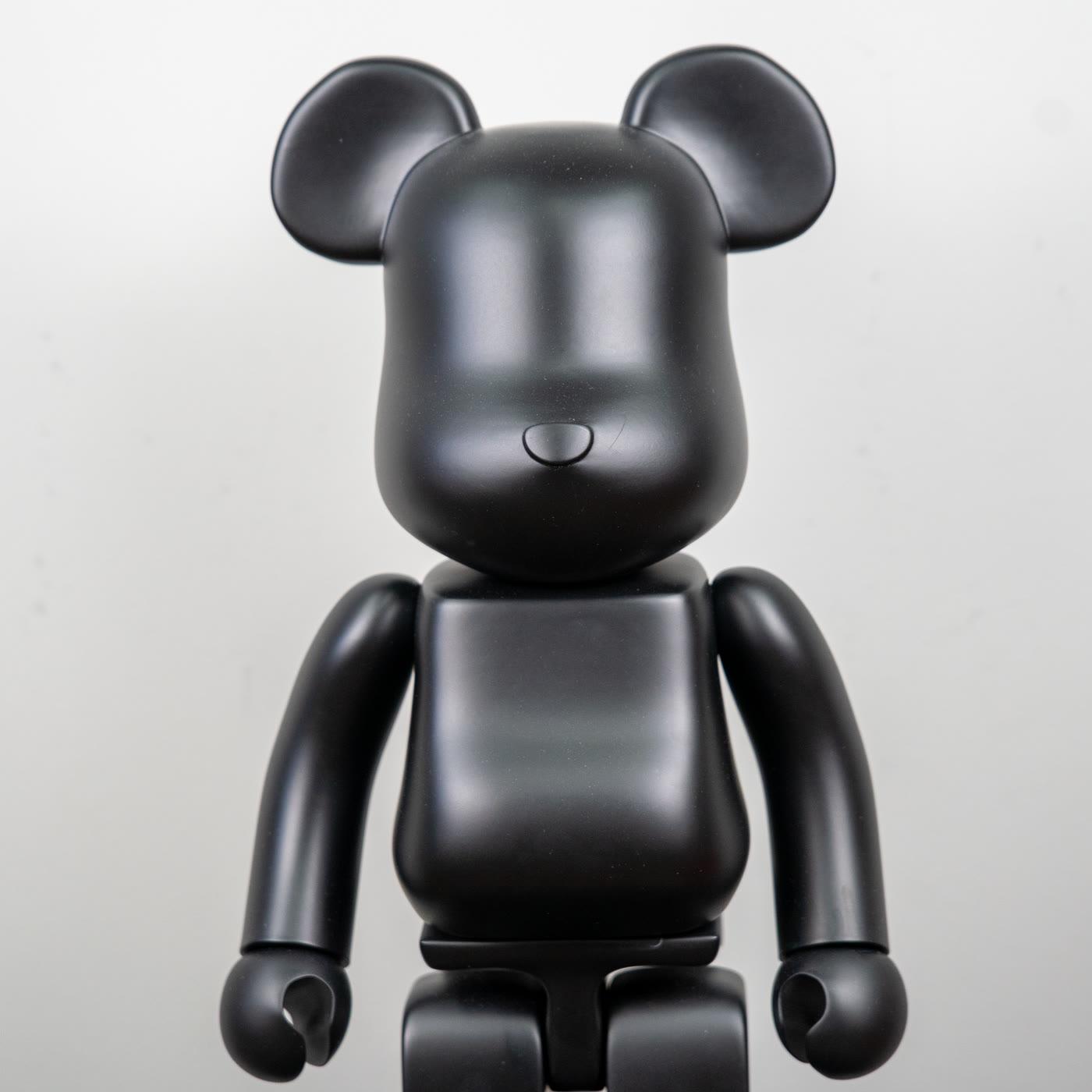
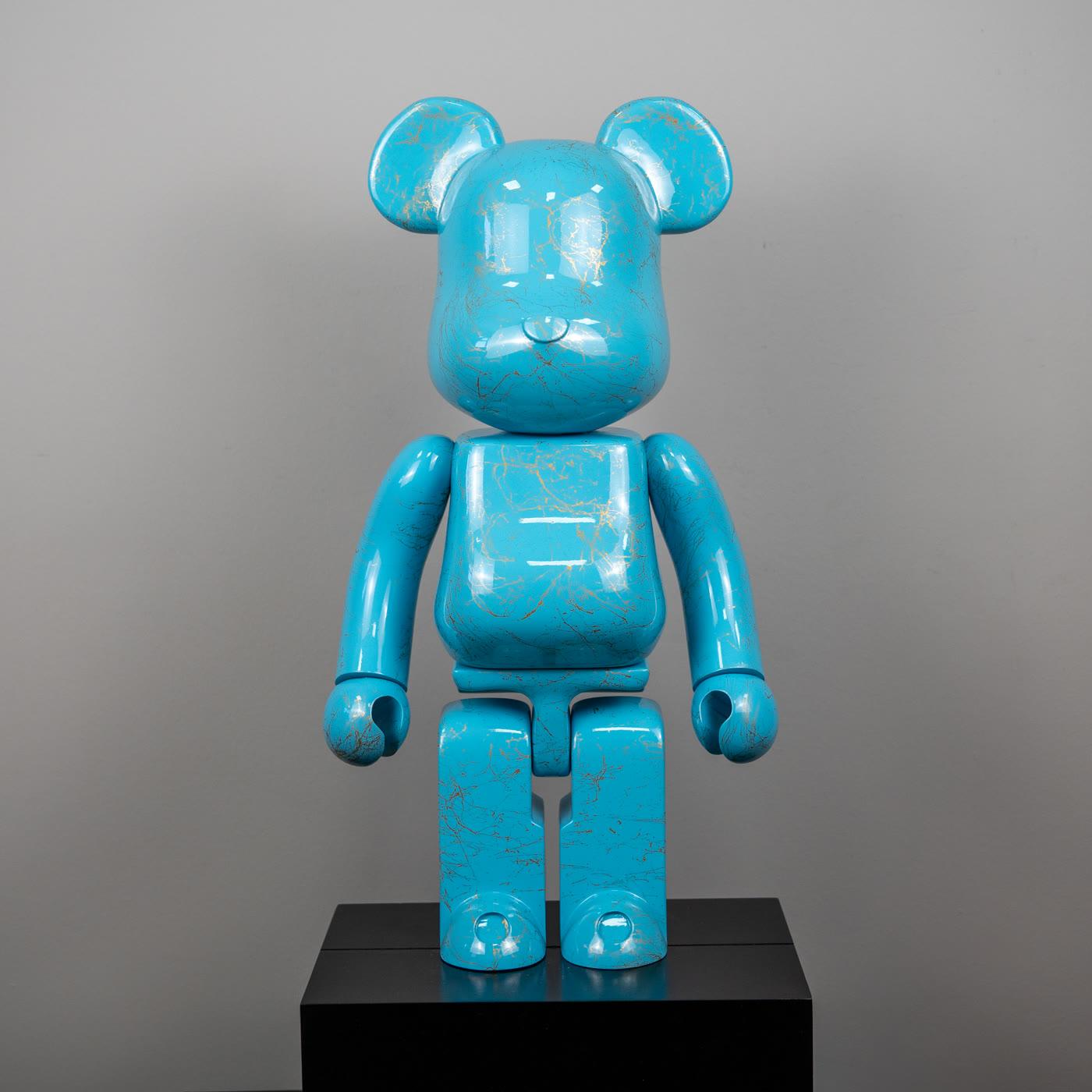
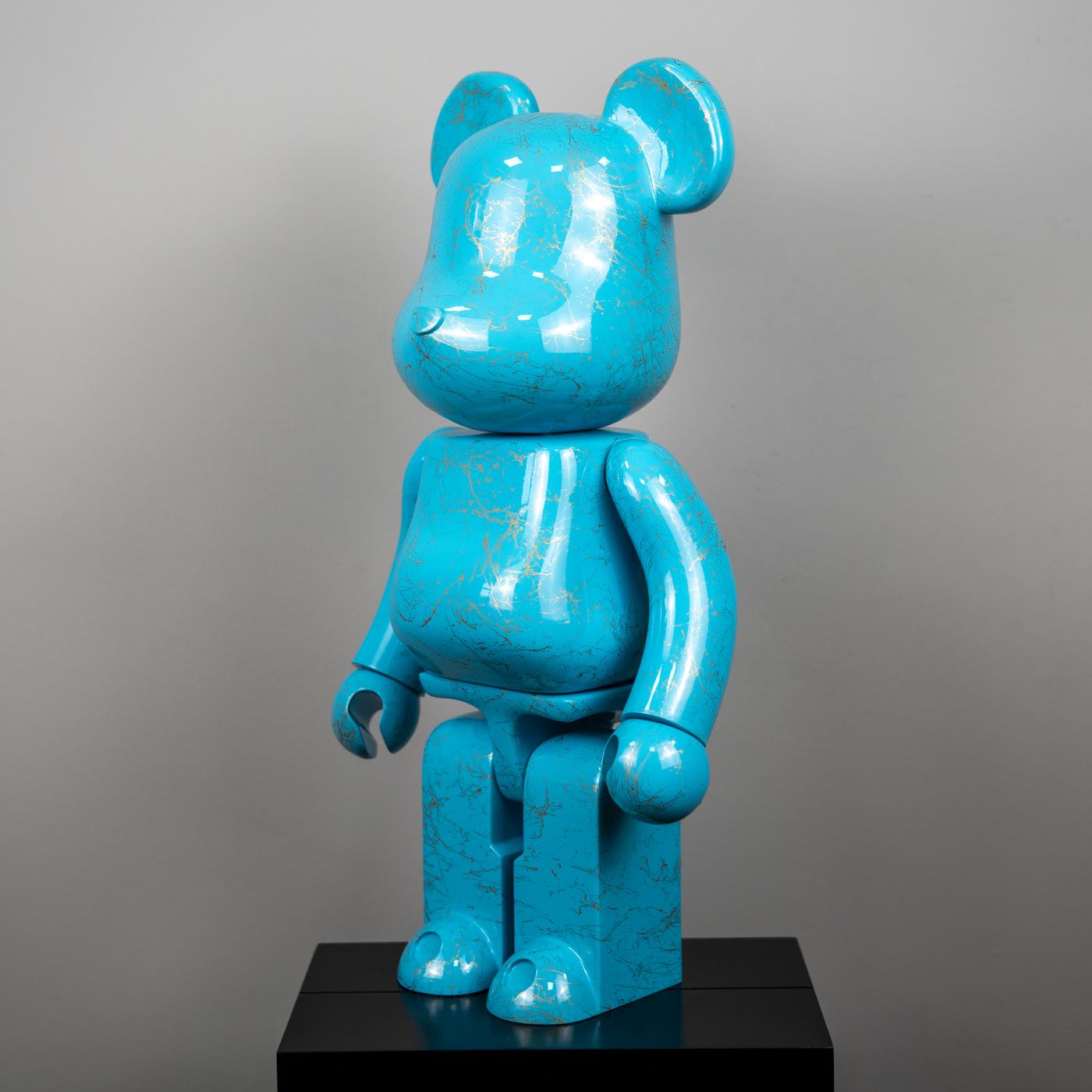
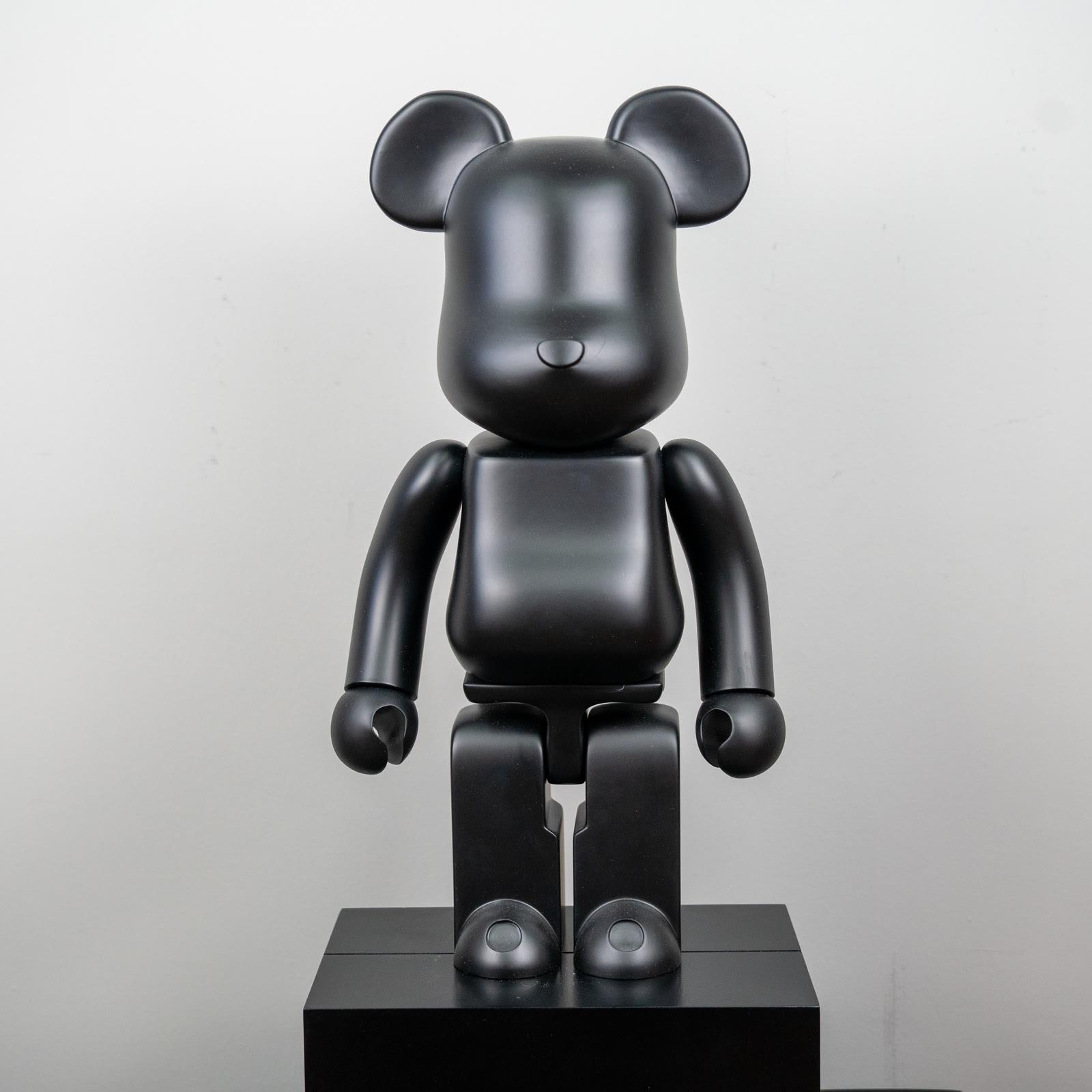
The matte black bear figure and the turquoise marble bear figure are decisions of finish and color. Their photographs are not captioned 100%, 400%, or 1000%. When size matters, the note on the piece’s own page and the place it will stand come first.
A percentage is not a quality grade either. A higher number does not mean a more correct figure. In Medicom’s chart the number is the name of a height. A percentage memorized without a room does not make choosing easier. Place first, then the name.
How many millimetres are 100%, 400%, and 1000%?
In Medicom’s published system, 100% is given as 70 mm, 400% as 280 mm, and 1000% as 700 mm. In everyday measure that is about 7 cm, 28 cm, and 70 cm tall. Seven centimetres is the scale of a palm and a desk. Twenty-eight is the scale of a shelf and a console. Seventy approaches a low plinth or the floor, and its visual weight is closer to a small piece of furniture.
These three are not the whole system. Other percentages exist. This article does not invent millimetres for those in-between heights. Every extra percentage on the chart, whatever its name, is checked against the manufacturer’s current table. If the table changes, a memorized in-between number misleads. Even the three main correspondences are worth confirming once on the current chart.
The comparison continues in 100, 400, and 1000, through the job each height does at home. The same rule holds there. The numbers belong to Medicom’s system. Catalog images are not read as photographs of those heights.
Why use a percentage instead of centimetres?
The percentage is a short way of saying that the same form has been enlarged in proportion. 100% is set as the base height. The other names read like a series built from that base. Collecting language preferred a shared scale family to saying 7 cm and 70 cm side by side. That is the manufacturer’s own naming choice.
The choice also sets a trap for someone looking from outside. A percentage feels grand on a screen. The words 400% can feel as if they stand in for more than a height of 28 cm. Feeling is not a chart. Set 280 mm beside a row of books and the height calms down. Bring 700 mm toward the line of a door handle and the height becomes serious. Carry the millimetres into the room, not only the name.
Why scale matters opens exactly here. The same silhouette behaves like another object when the height changes. A companion on a desk becomes a focus when the mass stands on the floor. The percentage is the label of that change in behavior, not the whole explanation.
How do you measure the room?
You read the room by measuring the width, depth, and viewing height of the surface where the figure will stand. On a shelf, a hand’s width of air on each side keeps the silhouette. On a console, a breath between the piece and the wall lets the shadow be read. On the floor, a level surface outside the path of walking is what keeps it from becoming a hazard. These measures apply to any large mass, apart from a Medicom percentage.
A photograph on a screen does not do this sum. A studio ground shows the figure in an endless gap. At home there is a lamp, a book, a door frame. The right scale is thought together with those neighbors. A matte black mass clarifies against a light wall. A glossy turquoise surface already speaks in color, so it wants a quieter neighbor.
The practical order is plain. Choose the spot. Mark the height with a tape. Place 70 mm, 280 mm, and 700 mm there with paper or tape, not only in the imagination. Then ask the catalog piece for its own size, without assuming a percentage. When the two facts speak in the same unit, the decision speeds up.
Which misconceptions about size are common?
The first misconception is to treat every bear in a photograph as 400%. In Medicom’s system, 400% is 280 mm. A product image carries that percentage only if it is stated. If it is not stated, it is not stated. The images that accompany this article on Popüler Sanat are not evidence of those heights.
The second is to assign round millimetres to the in-between percentages. Other heights exist in the system. Their match is the manufacturer’s current chart, not an invented formula. If there is no chart figure, there is no number. A guess leaves a surprise on the shelf.
The third is that a large percentage makes the piece more official. 1000% is a height, not a family tree. A logo on the foot, a box, or a hologram does not build an identity on its own either. Size information does not stand in for verification. It only describes how much space is taken.
How do these numbers relate to the catalog?
They relate like this: the shared thing is the silhouette language, and the thing not shared is a specific Medicom percentage. Matte black brings forward shadow and the gap at the joints. Turquoise with a fine gold marble pattern gives light back as color. Both are decorative figures in the Bearbrick selection. Their heights are not announced as the 70, 280, and 700 mm of this article.
The sound way to relate them is to separate finish from size. Color looks at the room’s palette. Size looks at the centimetres of the gap. Joining the two in one excited sentence ends with a piece that is too large, or a piece whose color disappears. The products page sets the bear figure beside other masses and makes that separation visible.
What is the last check when choosing a size?
The last check is to say the three numbers once more, in place. 70 mm is the desktop. 280 mm is shelf height. 700 mm is floor and low-plinth height. Every other percentage earns millimetres only from Medicom’s current chart. A catalog piece is not called by one of these three names.
That quiet repetition cuts the hurry. If a loved color is larger than the gap, the form is crushed. If the gap is very wide and the piece very small, the figure stays like a trinket. Either can be a legitimate choice. If the choice is built on a measured gap rather than on the feeling a number creates, the figure sits easily in the room. The size system exists to make that possible.