A language already in circulation
KAWS is not a commentator standing outside popular culture and pointing at it. The working name of Brian Donnelly, born in Jersey City in 1974 and begun in graffiti, carries the plain face of the cartoon, repeated colour, and a recognisable body into sculpture. The Companion is the centre of that carrying: a rounded, skull-like head, X-shaped eyes, gloved hands, shorts, and boots. People recognise the silhouette at the speed of a mascot. Recognition is popular culture itself. The rest of the work is to hold that recognition at the slowness of sculpture.
Popular culture is not a decoration here. The character speaks a visual grammar people already know. Closed eyes, gloves, shorts, boots: each arrives from cartoons and costumed heroes, then sits in the weight of a sculpture. Popular culture's place in art keeps that ground wider. With KAWS, the question is how steadily that ground is tied to one character. The Companion does not arrive and leave like a seasonal joke. It returns for years with the same face. Repetition is a method of popular images, and here it has been handed to sculpture.
A neighbour to Warhol
KAWS is often named beside Andy Warhol. The neighbourliness is real. The identity is not. Warhol entrusted faces and packages that already circulated to the repeat of print. Warhol's method lives in screenprint, in the famous face, and in goods from the shelf. KAWS designs a character and spreads that character through painting, sculpture, and widely seen commercial collaborations. Both take seriously a language crowds already know by heart. One multiplies an existing image. The other builds a new body and leaves it inside the existing world. Generation and tool both differ.
Keeping the distinction stops KAWS from being slipped carelessly under a pop art umbrella. The shared interest is the image in circulation. What is not shared is the Companion's lock on a single designed face. Warhol's Marilyn is a face that was already famous as a person. The Companion's face was designed before it was famous. Fame follows the design. At home the difference is felt this way. A poster brings in a star you know. A Companion brings in a body you did not know and learn immediately. Both belong to popular culture. They do not come through the same door.
How the character travels
A painting stays on the wall. A sculpture is walked around. Commercial collaborations take the character into the shop, the garment, and the screen. We will not invent years. What is visible is enough. The Companion left the studio's immediate circle and met a much wider public. That meeting does not shrink the work. When popular culture shows a sculpture's photograph millions of times, people learn the character on a screen and then look for it in a room. The order is sometimes built that way. The work in a museum and the familiarity on a shelf are not the same thing. They feed each other. They do not replace each other.
The collection figure stands in exactly that gap. A body, smaller or larger, makes the character holdable. Designer-toy culture enlarged that desire. Even so, every figure is not the artist's own sculpture. The pieces in the Popüler Sanat catalogue are finished collection objects that carry the silhouette and the pose. The honest sentence also fits the promise of popular culture. People approach because they recognise the character. Once they approach, they need to know what the piece in hand actually is. Recognising and owning are not the same door.
A covered face slows the culture down
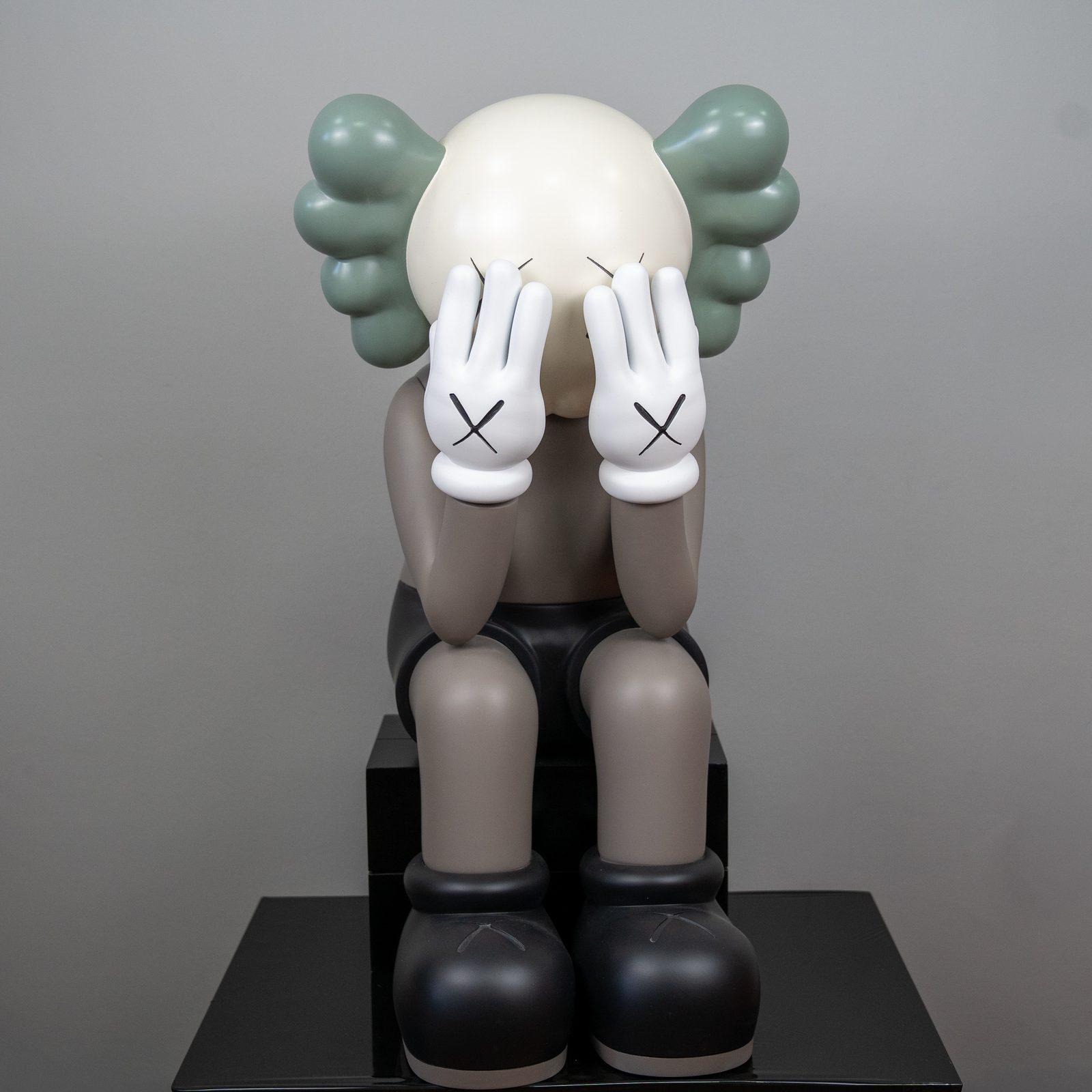
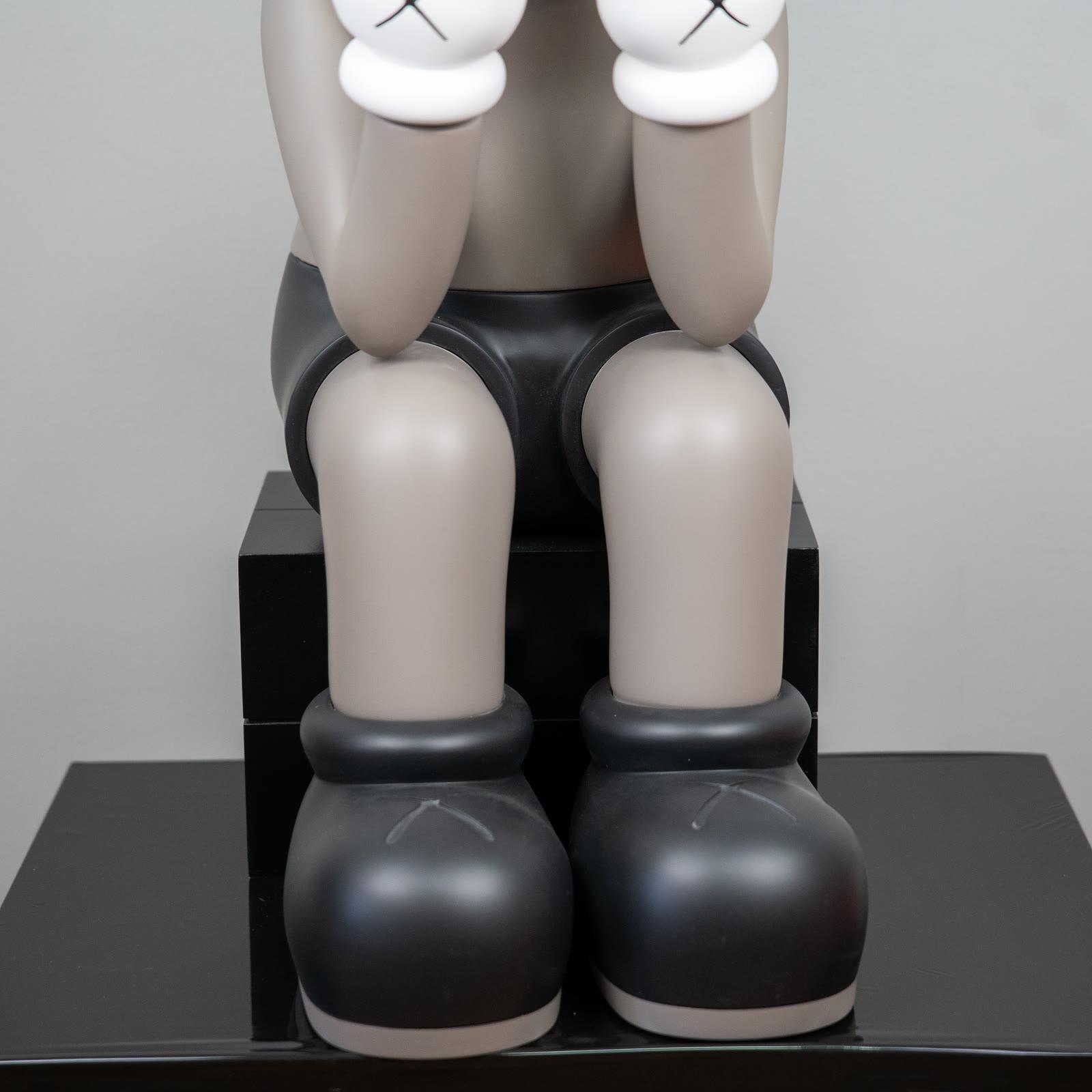
Popular culture often shouts. Covers, posters, and shop windows are designed to be read in a second. The Passing Through pose works against that speed. The Companion sits, and the hands cover the face. The name of the pose is not a quotation. It describes the posture. When the face closes, the character suspends its own popularity for a moment. The X eyes are hidden, the mouth disappears, and the greeting stops. A viewer may read a pause or a withdrawal. That reading is the pose's invitation. It also remembers that not every image in popular culture is obliged to be cheerful.
A calm colour such as taupe supports this slowness. A body that does not shout lets the gesture of the closed hands come forward. A room works the same way. A figure squeezed opposite a television, inside a crowd of posters, returns to the noise of the culture. A figure left in front of an empty wall stands like a sentence chosen out of that noise. A character that comes from popular culture does not have to imitate popular culture's tempo at home. Its best moment is the moment it slows that tempo down.
Comic surfaces, side by side
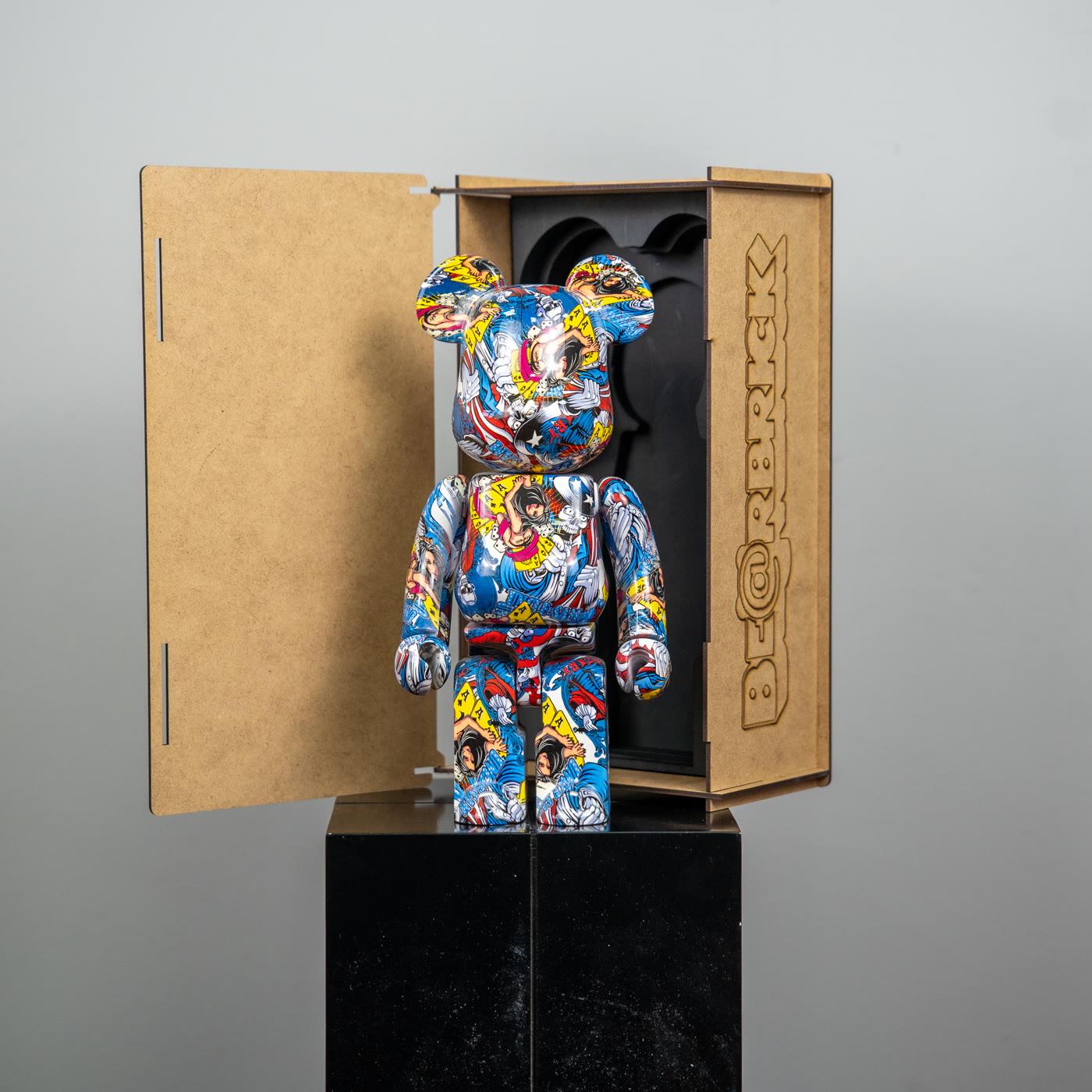
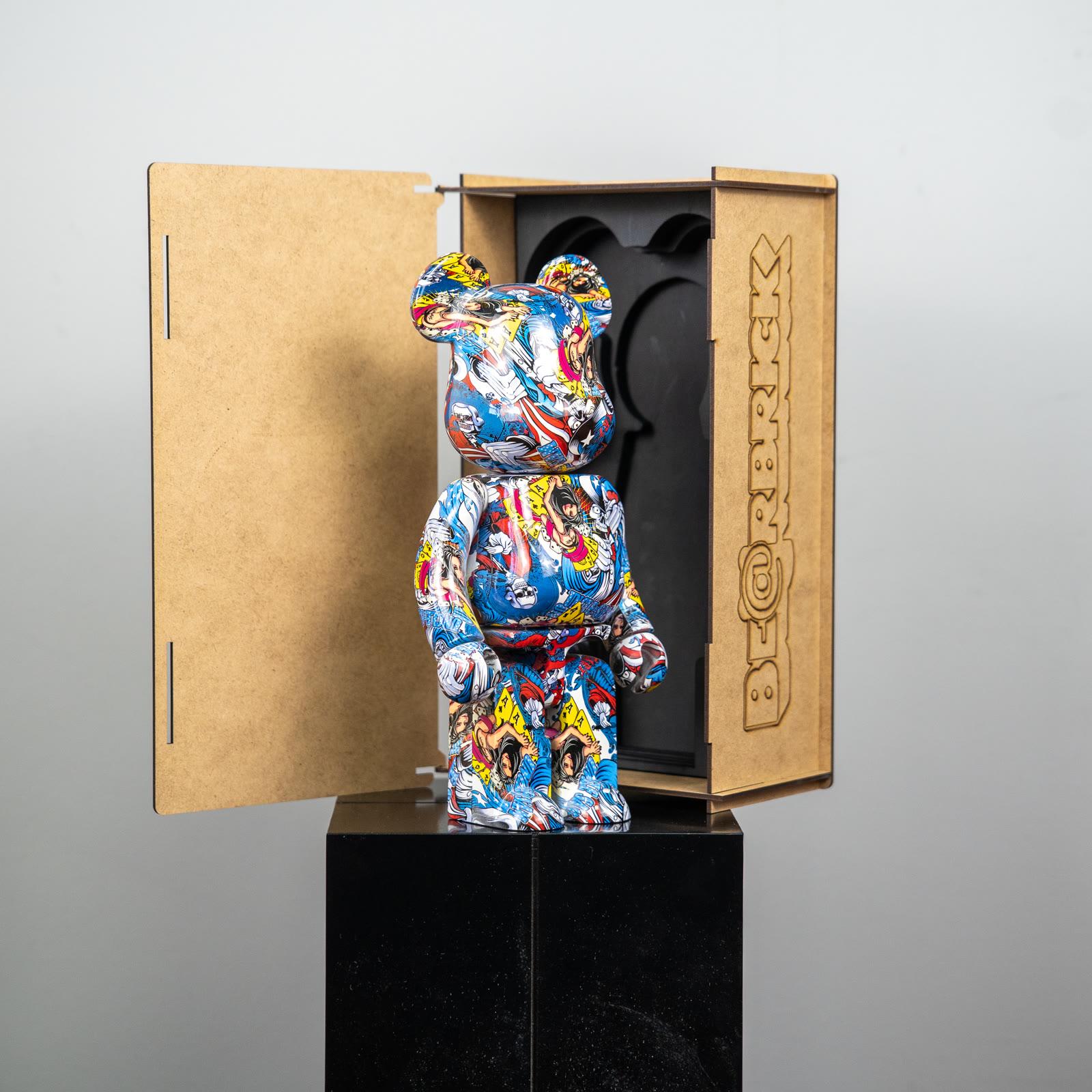
Another face of popular culture is the printed grain of the comic. Dot, frame, and flat colour are read quickly on paper. The comic-print Bearbrick carries that grain onto a different collection body. It is not the same object as the Companion. Two popular languages can share a home: one is a skull-like head and an X eye, the other is a printed surface breaking across a bear. They do not need to build a museum thesis when they sit together. Both begin in a graphic world people already know.
The confusion is to treat that neighbourliness as one brand. Bearbrick is another line of culture, held under its own name on the Bearbrick page. KAWS speaks through the Companion. Putting the two on one shelf shows that you like popular culture. Counting them as the same artist means not reading the shelf. A calm home can stay warm while keeping the distinction. What they share is graphic nerve. What they do not share is the shape of the head and the mark of the eye. Separating them is a way of liking both more clearly.
Equivalences that do not hold
The first equivalence makes KAWS the same movement as pop art of the 1960s. The interest is related. The history is not the same. The second treats every commercial collaboration as the end of the art. The character also stands in painting and sculpture. Circulation is added beside that work. The third counts every Companion silhouette as an original sculpture. A catalogue piece is the language at the scale of a home. The fourth takes the X eye for a popular slogan. Critics and viewers have read the mark as erasure, as a cartoon eye, and as expression flattened into a sign. Those are readings, not a sealed motto.
A fifth equivalence is quieter. It assumes that everything popular must be decorated at a shout. The Companion's strength is that it can be familiar and still fall silent. Passing Through shows this in particular. When the hands reach the face, the character stops being a poster and becomes a posture. If your home loves popular culture, the only form of that love is not more posters. Sometimes one seated figure speaks more clearly than a whole wall of paper. Reducing is not a denial of the culture. It is a choice inside it.
Choosing popular culture at home
The taupe Passing Through is a calm example of that choice. The figure sits, the hands cover the face, and the colour is warm and low-voiced. It brings a popular character home, then refuses to make it shout. A sage standing Companion builds a more open greeting. The taupe seat cuts the noise of the room. Which one belongs to you becomes clear beside the other images on your wall. If posters, records, and a screen are already talking, a covered face is a good guest. If the wall is empty, the standing figure greets that emptiness. Both come from inside popular culture. They do not make the same sound.
The crossing into fashion and design is kept in a separate essay. This page holds why the character is so familiar, and why that familiarity does not cancel the seriousness of sculpture. Neighbourliness with pop art is left at the door. One body is brought inside. The Popüler Sanat catalogue offers that body without inflating it. If you keep the same measure in the room, popular culture stops being a noise. It becomes a chosen face. If the face is covered, the choice grows quieter still.