
Where do you place a large figure?
A large figure belongs where the eye already wants to stop. The end of a hall, a quiet corner of a living room, the side of a stair, or the axis of a lobby entrance are such places. The piece should not be dragged in like luggage. It takes its place as a mass you pause for.
Size does not mean every room can carry it. In a narrow corridor, shoulders that meet the wall make the figure feel stuck. Under a low ceiling, a top that competes with a lamp breaks the silhouette. The right place lets you walk around the piece and leaves air between its top and the ceiling.
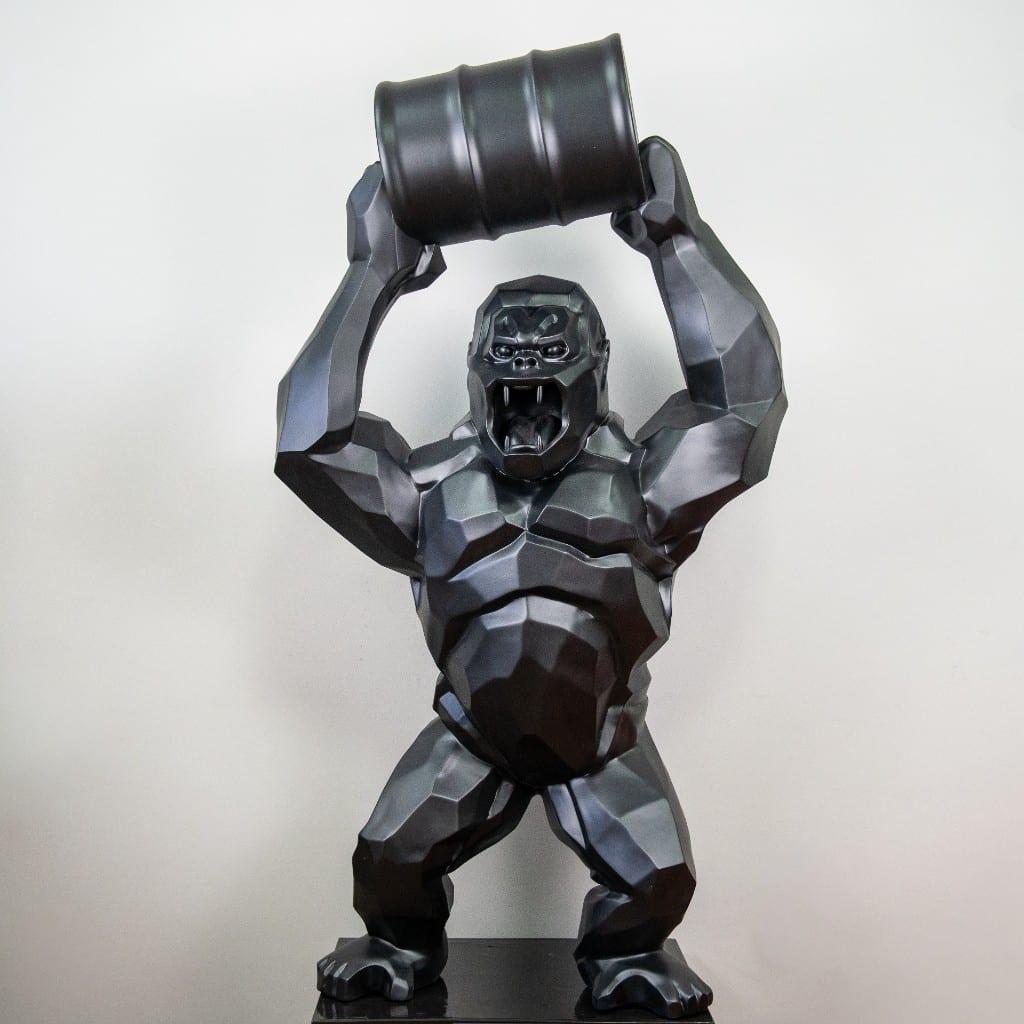
The matte black faceted gorilla makes the calculation concrete. An angular shoulder, a barrel overhead, and an upright stance read from across a room. Forcing it onto a console shrinks the mass. Setting it on the floor, or on a low wide plinth, gives the form its job back. The broader logic of scale sits in choosing the right scale.
Scale is a matter of volume
A large figure works through the air it occupies, beyond its height. Arms, a barrel, a base, and a shadow all belong to that air. Measuring only from top to bottom hides how the piece cuts the room. How close your shoulder comes when you pass is a better measure.
Volume has to be thought with the furniture. If a sofa, a console, and a sculpture occupy the same triangle, the eye does not know where to sit. Moving the sculpture outside that triangle, into its own air, relaxes the sofa too. A large piece should not be hidden inside the seating group.
Light is part of the volume. Matte black swallows shadow and shows its edge when light comes from the side. A metallic color makes the same form feel wider, because the room reflects in the surface. Two finishes are two different volumes of one sculpture.
Floor, plinth, and eye level
The floor is the large figure’s first neighbor. Pale stone or quiet wood does not cut the silhouette. A busy rug swallows the feet and the base. If the rug stays, move the piece onto the calmest part of the pattern, or set a plain wide plate beneath it. The plate does not need to be a second ornament. A boundary is enough.
Eye level changes between someone walking and someone seated. In a hall, the piece works when the shoulder line sits near a walking gaze. In a living room, a top that floats too high above a seated eye becomes only a mass. Moving the piece a little farther back brings the whole silhouette into the frame.
Remember the swing of a door. A large form standing inside that arc becomes an obstacle at every entrance. A point outside the door’s rest, still visible at first glance, is kinder. The piece greets. It does not block the path.
Misreadings about large figures
The first misreading says that large automatically makes a room impressive. A large form in the wrong corner shrinks the room. The same form in the right corner gives the room a measure. Presence comes from a calm placement.
The second misreading pushes the figure flat against the wall. A back glued to plaster erases depth. An angular shoulder and a barrel overhead need air behind them too. Half a step forward lets the shadow draw its own line on the wall.
The third misreading lines small objects at the feet of the large one. Piled there, they look like a staircase. If the large piece can stand alone, leave its side empty. If something must accompany it, let that something come from another scale and another distance. A single statement piece defends that solitude.
One form, two colors
Two finishes of the same sculpture are two placements. The matte black gorilla stands like a sculpture on a pale wall. The edges are clear, the shadow is long, and the room accepts it as a mass. On a dark wall it becomes almost a silhouette game, and without help from light it disappears.
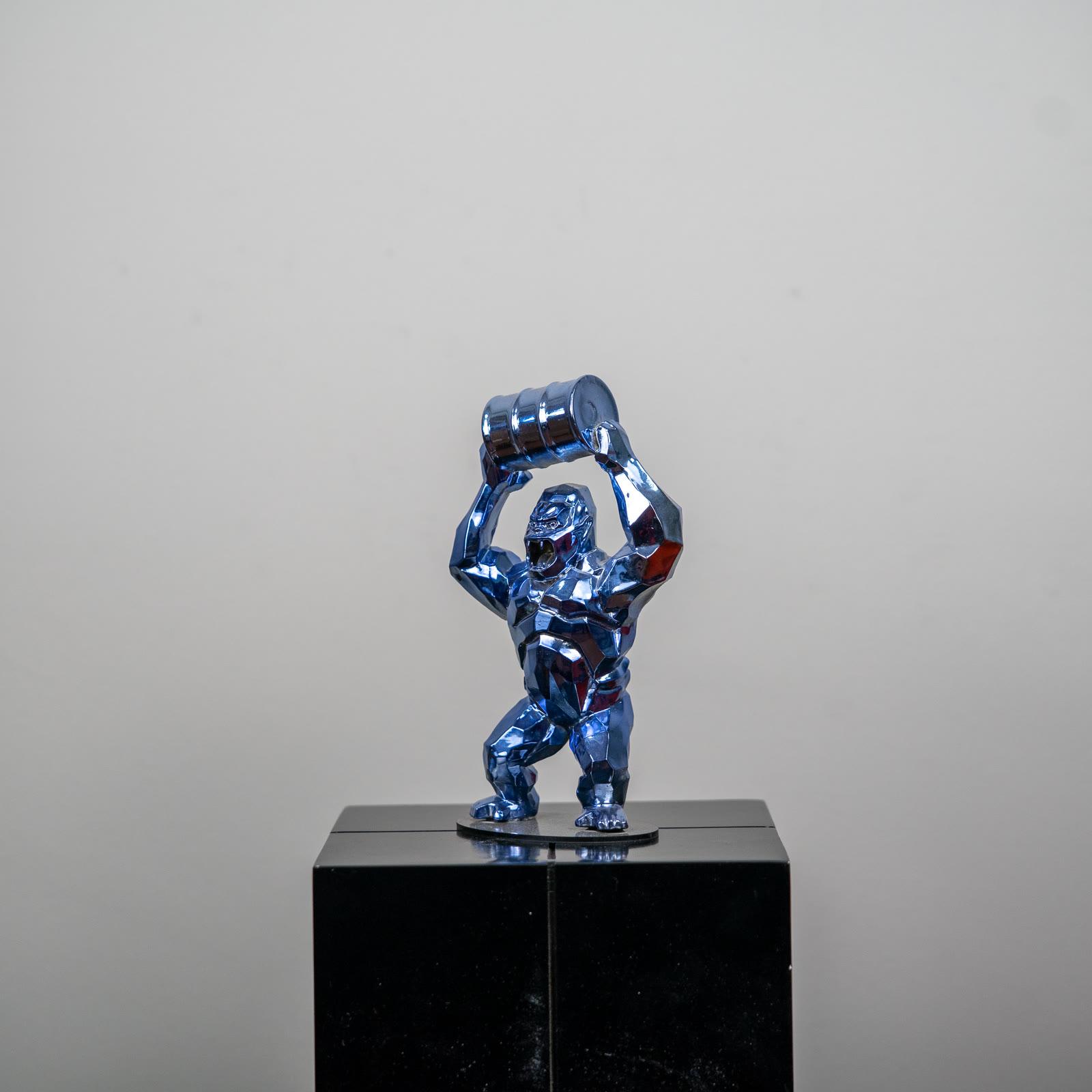
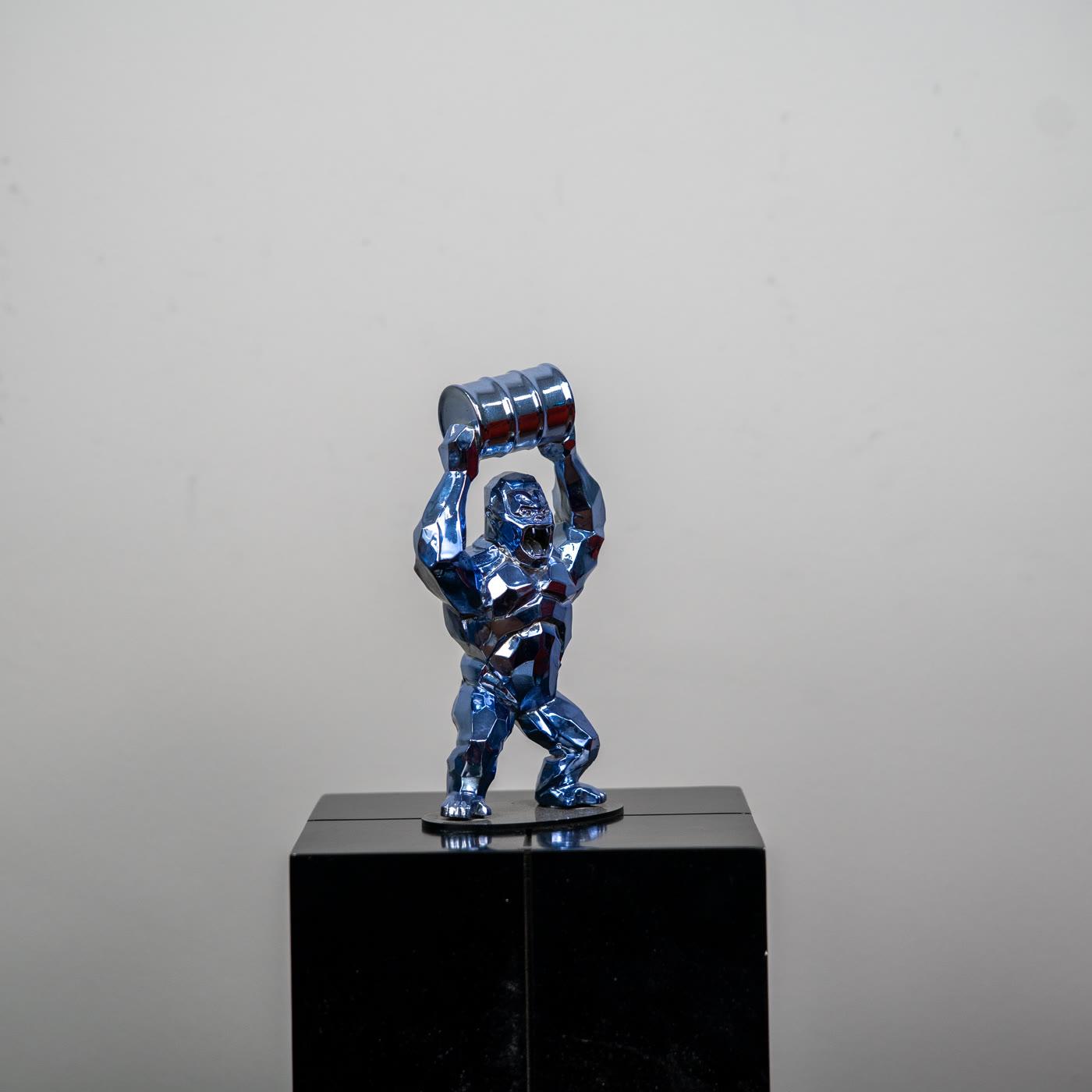
The electric-blue chrome gorilla says the same pose at a higher volume. The metallic surface takes in the lobby light, the window, and the people passing. It works better on a quiet floor with little furniture. In front of a crowded shelf, the reflection turns into noise.
Facing the two across one hall is possible, and it reads as a declared pair. In most homes, one is enough. Black enters a classical, darker palette. Blue talks to glass, metal, and pale stone. Choose the color beside the sentence the wall is already saying.
A practical placement
Set the piece temporarily near the middle of the room and walk around it. Note where it appears as you enter, and where it vanishes once you sit. The lasting place is visible from the door and stays out of the seating line.
Then check the top against the ceiling and the lamps. If the barrel shares its air with a pendant, shift the lamp or move the figure a step aside. Two vertical accents should not meet at the same point.
A large Bearbrick follows the same logic of volume; the detail is in placing a large Bearbrick. The shared lesson is to stop memorizing scale as a number. Measure by walking the room. The larger forms in the collection settle after that walk.
Let the room keep the figure
A large figure does not have to apologize to the rest of the room. It also should not consume the room alone. The right place is both visible and passable. The person who sees it stops. The person who is passing continues.
Matte black and chrome blue say the same decision in different light. Choosing one is choosing the palette of the house. Putting both in every corner cancels the palette.
Leave the figure alone for a day. If you want to add something around it, ask the next day whether you still do. A large piece prefers a patient neighborhood.