
Scale is a relationship, not a measurement
The right scale is the figure’s relationship to the furniture beside it, the ceiling above it, and the distance from which you first see it. A millimetre on a box is not the size of the living room. We do not assign centimetres to our pieces as a room formula. A mass that feels large on a dining table can feel measured in a tall niche. The reverse is also true: a figure that looks small on a wide, empty console looks lost, not refined.
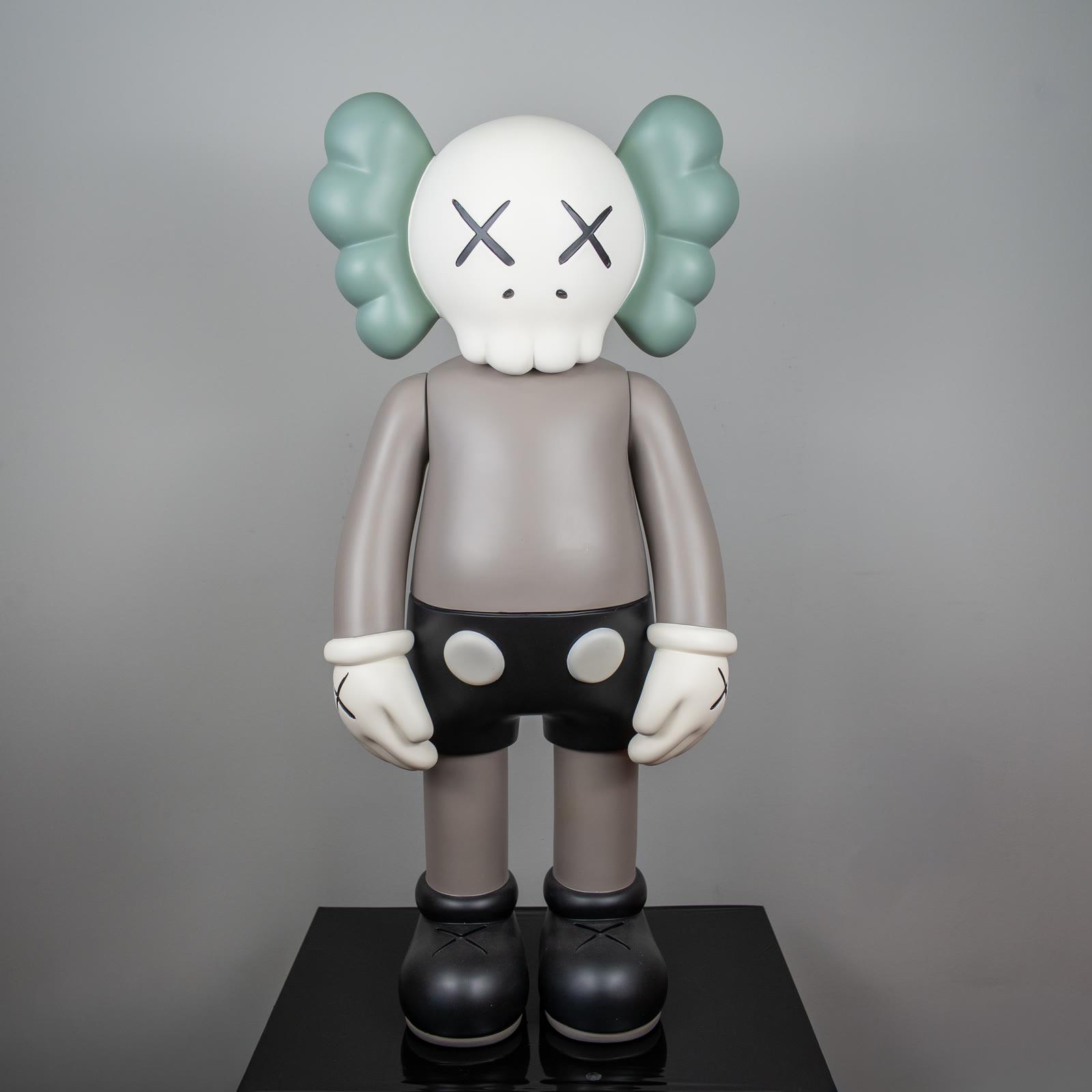
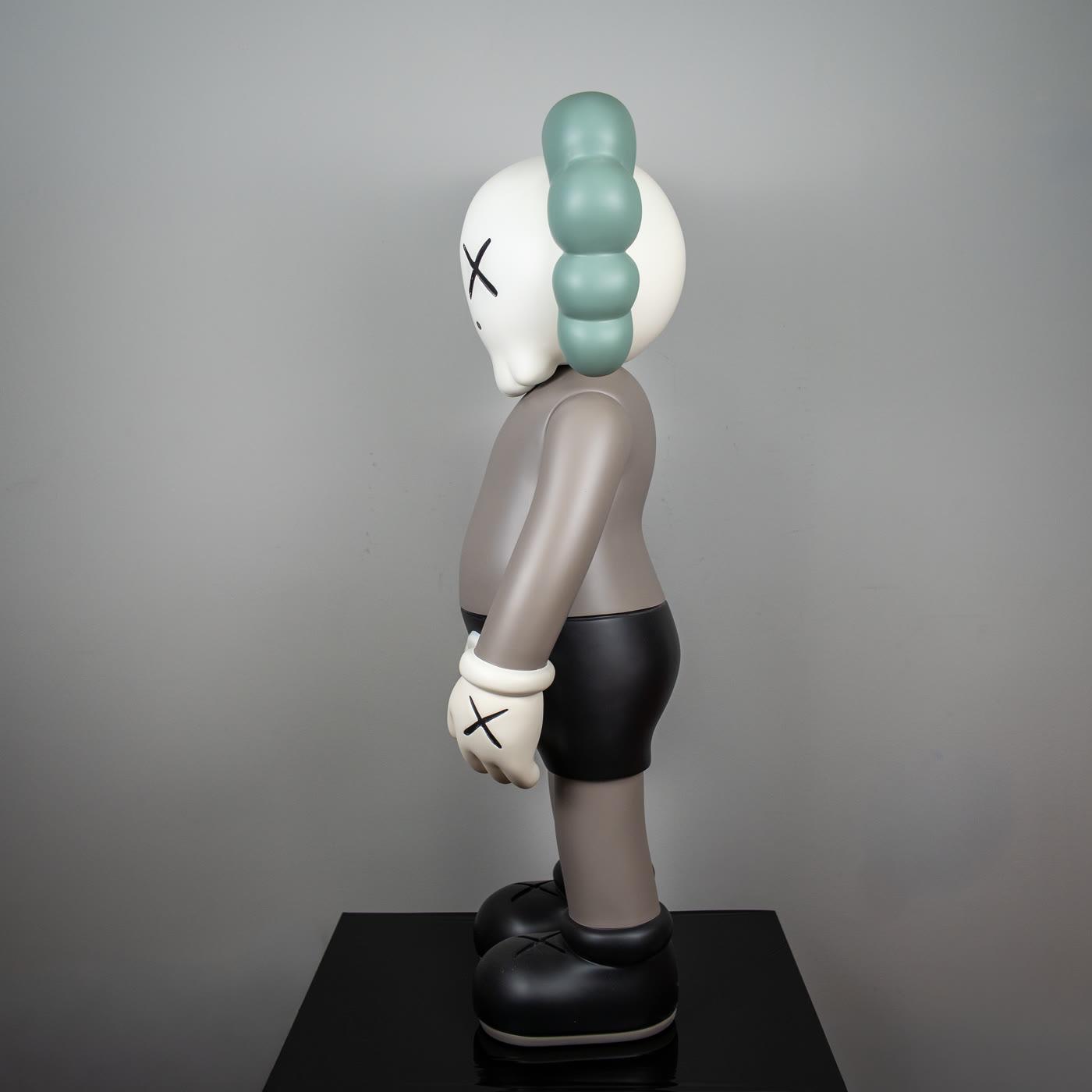
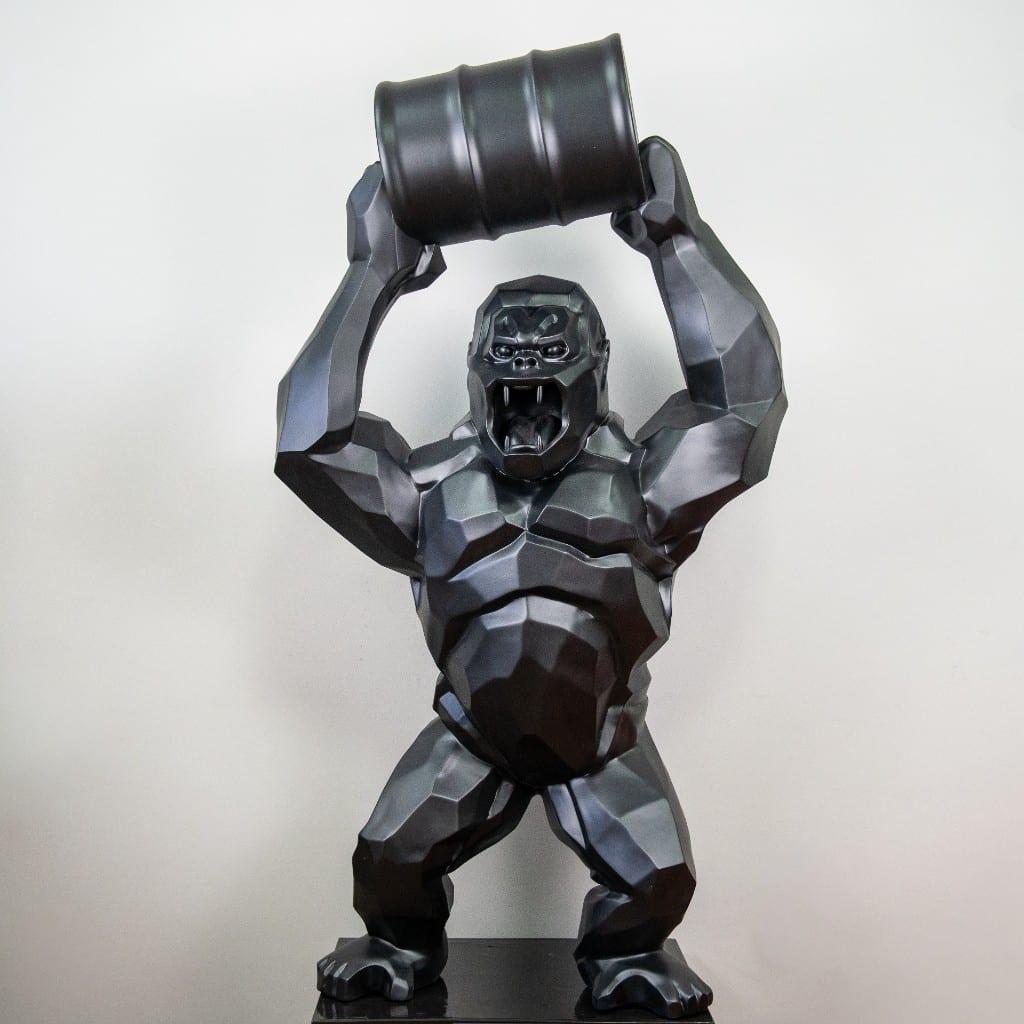
Two gestures cannot be counted as one. A faceted gorilla holding a barrel overhead takes air above the shoulders. A standing Companion is a vertical silhouette, close to a person. One does not substitute for the other. Why scale matters opens that relationship more widely. Here the choice is between the room you have and the gesture you have.
Sofa, console, and table
Set the figure next to a piece of furniture you already know, and look. The sofa arm, the height of the console, the head of a table lamp. Those are your ruler. Far below the arm, and far away, the figure reads as a table object. Near eye level, it reads as sculpture. Both are possible. Do not confuse them. Describing a table object as the focus of the room misleads the room.
On a narrow console a wide mass stops being a plinth’s guest and becomes a crushed shelf. On a wide reception surface the same mass can breathe. A desk is for work. Choosing scale for the desk puts the piece in a race with the keyboard. The matte black faceted gorilla is not a desktop candidate for that reason. A corner, a bare wall, and the second glance of someone walking in are a better distance.
A ceiling presses, or it swallows
Under a low ceiling, leave air above the head and above the gesture. Pushing the barrel into the ceiling does not enlarge the piece. It lowers the room. Under a high ceiling the same piece can shrink at the foot of a huge empty wall. Try the plinth, or the viewing distance, before you assume you need a different sculpture. Let the plinth be kin to the other wood in the room. A random carton does not correct scale. It enlarges the clutter.
Ceiling height does not decide alone. In a tall room, a piece on the floor far from the door appears only when someone is already on top of it. That is also a scale error: distance has eaten the height. Keep the piece on the line where the eye falls, at a height that is not fighting the ceiling. Large-scale figures describes how a big mass breathes in a lobby-like volume. At home, the same bulk can fight a low ceiling.
The first look from the door
Choose scale by looking from the door, not by standing beside the piece. Up close, every figure is large. From the threshold, either one silhouette separates or it disappears among the furniture. If it disappears, it is too far, or too low, or too crowded. The first remedy is not a different height. It is a different place.
The sage Companion builds a vertical silhouette, standing, with sage ears and a taupe body. Up close, the face and the gloves can be read. From farther off it stands like the contour of a person. Leave it on the floor in a corner the door cannot see, and the room will not use it, whatever its scale. A place near eye level, with a margin of bare wall, legible from the door, builds the right relationship without quoting a measurement.
The Bearbrick chart is not a room formula
Bearbrick has a size language of its own. The percentages on the Medicom chart describe how the figures relate to each other. Bearbrick sizes explains that chart. The chart does not say which percentage a room requires. We do not stick those percentages onto our pieces as a room recipe either. A bear silhouette can sit on a small shelf or in a more assertive niche. The decision belongs to the sofa, the ceiling, and the door, not to the chart.
A higher percentage does not automatically make the room right. A large bear is an obstacle in a narrow hall. A small bear is a stamp on a huge empty wall. Both can be legitimate pieces, standing at the wrong distance. Read the chart, then leave the chart outside the door. The room talks to its own furniture.
Mistakes that keep coming back
The first mistake is thinking scale is the single number on the box. The second is thinking large always dominates and small always disappears. The third is thinking ceiling height decides alone. The fourth is swapping the gorilla and the Companion because both are bulky. One takes air. The other builds a vertical body.
The fifth mistake is mistaking the empty grey ground of a catalog photograph for your floor area. A backdrop is not a project. The sixth is hiding the plinth and forgetting the piece on the floor. The seventh is carrying the same height into every room. A living room, an office, and a narrow hall do not offer the same distance. Walking the collection is for seeing the gesture, not for ranking heights.
Try it in the room before you choose
If you already have the piece, set it on the candidate surface for a day. Come in from the door, sit, then stand. If the silhouette separates in all three, the relationship has held. If it does not, change the height or the distance. If you do not have the piece yet, put an object you know on that surface and look at the air. A table lamp, a stack of books, a vase. Decide whether the figure wants more air than that gap, or less. Then choose the gesture: a vertical body, or a mass that needs air above its head.
The line a child or a pet can reach, the walking path, and the top of a radiator are the wrong address even when the scale is right. The right height in the wrong place is still wrong. If a week later you still find that silhouette from the door, the choice has settled. If you do not, try a barer neighborhood before you try a larger piece.
If the relationship holds, the scale is done
Scale is not a title the piece gives itself. It is the place the room gives it. If the gorilla’s barrel is not fighting the ceiling, if the Companion reads from the door as a body, and if the sofa is not crushed, the choice is right. A measurement is not inside that sentence.
Read the chart for Bearbrick. Read the room with the furniture. The two readings do not replace each other. When the collection grows, do not match every new piece to the height of the last one. Each room asks its distance again. The right scale is the calm answer to that question.