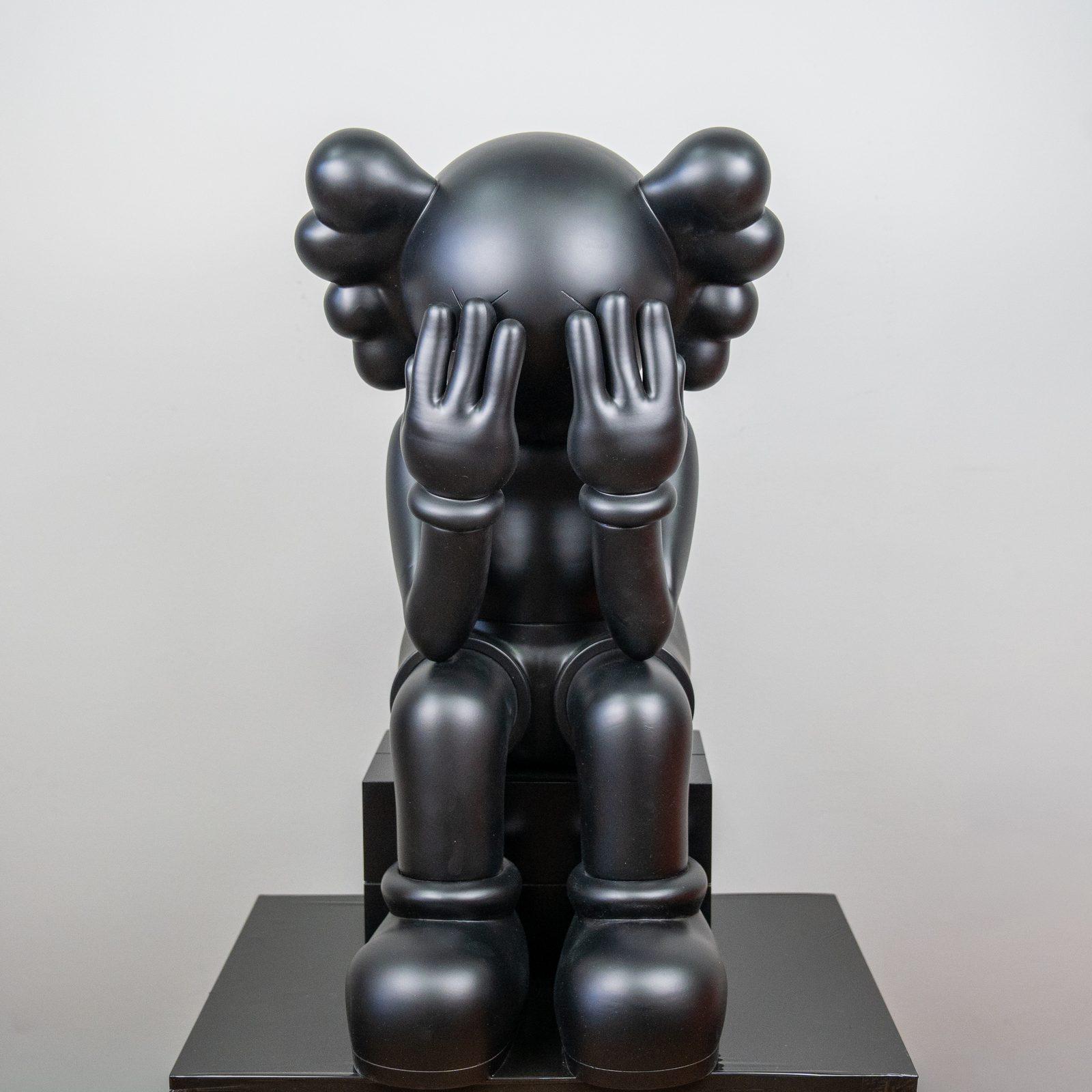


Minimal does not mean colorless
A minimal room does not ask for colorless objects. It limits the number of decisions that compete. One color you can defend is enough. A glossy red bear with a gold marble pattern can be that saturated decision. A matte black figure that covers its face nearly removes color and leaves the pose. Both are minimal. They are not the same sentence.
If the room is already plaster, pale wood, and a plain textile, a red object is a pulse. If the architecture is the subject, matte black can stand without disappearing into the wall. Putting both into a small room splits the story. Walking the collections, ask the same question: is this piece the single event, or the quiet version of the room?
One saturated object
The red marble bear carries a glossy red body and a gold marble pattern. The marble pattern behaves like a second color. Do not add a yellow cushion, a blue poster, and a green vase beside it. Let the neighbor be white, stone, oak, or undyed linen. Then the red can be read. In a crowd it becomes one more ornament.
A glossy surface shows the lamp on its face. Take the light from the side, and keep it soft. Directly under the ceiling you get the bulb, not the marble pattern. Do not park it in the afternoon patch of sun. Red is a color that shows fade to the eye early. That does not mean other colors are safe. You simply notice sooner. Leave bare wall around the piece. A gallery habit is the plainest way to enlarge a color: keep the frame empty.
The quiet work of matte black
Matte black Passing Through sits and covers its face. The surface is soft and the reflection is low. Color is almost absent. In a minimal room this is the second legitimate path. The pose does the work. Push it against a dark grey wall and the silhouette dissolves. On a light wall, or a light surface, the edge comes back.
The gap between the hands and the face is where the piece is read. Do not close that gap with small objects. Alone, on a surface that is low but not forgotten on the floor, the room can breathe. If the red piece is a pulse, this one is a pause. Decoration with Bearbrick describes how a bear silhouette can multiply in a room. Here we are not multiplying. One black, one room.
Do not put both on the same view
Red and matte black stand on the same shelf like samples. One shouts, one is silent, and both stay half finished. If the home has two rooms, the split is easy. If it has one room, think in seasons: red for a while, black for a while. Showing both at once is not displaying a collection. It is indecision.
Repetition, scale, and empty space are the other decisions in the same family. Color, scale, and repetition ties those three together. In this article repetition is deliberately scarce. One object. One ground. One light. A third color and the minimal claim drops. It may drop. That is also a choice. The name for it is then a controlled crowd, not a minimal room. Name it honestly.
Mistakes that keep coming back
The first mistake is thinking minimal means white furniture and zero objects. An empty room can be a decision, but buying a figure is already a step outside it. Once you have stepped, one strong object is plainer than ten pale ones. The second mistake is believing one red ruins the calm. What ruins it is the second color and the third, gathered around the red.
The third mistake is treating black as the only minimal option. The fourth is calling the marble pattern busy and hiding the piece on a crowded shelf. In quiet company the marble pattern is a pattern. In noise it is a stain. The fifth is mistaking the grey background of a catalog photograph for your wall. A studio ground is not a project. Your plaster, your curtain, and your wood are another room.
Wall, wood, and cloth
A plain wall beside the red piece is enough for the marble pattern to be read. If the wood is warm, the gold marble pattern can be kin to it. A cool grey stone also works, as long as no other jewel tone stands next to it. If the textile has a pattern, put the figure where the pattern ends, not on top of it. Two patterns eat each other.
With the matte black piece the neighborhood works in reverse. A very dark niche swallows it. A light plane makes it sculpture. On both pieces, take the daily objects off the surface. Keys, a charging cable, and a stack of cards end a minimal claim in a day. Let the surface be the piece’s plinth, not the top of a drawer.
Do not lock the decision before you live with it
Set the piece where you mean it to live, and look once in the evening and once at midday. Red can feel warmer under a lamp and harder at noon. If neither bothers you, the decision has held. If matte black disappears in dim light, open the ground or move the piece to a brighter wall. Take a neighbor away before you buy another object.
Dust dry and soft. Glossy red scratches. Matte black collects oily fingerprints. Do not make the sun its permanent address. If you are still looking at that single object a week later, the room has accepted the color. If you are not, either the piece is shouting too much or the room around it will not be quiet. The Bearbrick page and a seated black figure answer the same question in two ways. Choose one answer.
One decision, one room
In a minimal room, color is not a ban. It is a budget. You spend one saturated red, or you spend no color at all and leave the work to a matte black pose. Spending both in the same view breaks the budget. If the wall is bare, the neighbor is calm, and the sun is not living on the piece, the job is done.
Come in through the same door the next day. If the eye goes to one thing, the minimal claim is standing. If it goes to three things at once, take something away. When the collection grows, refusing to carry every new color into this room is also a minimal decision. Storage is half of display.