
How do 100%, 400%, and 1000% compare?
100%, 400%, and 1000% compare as three published heights in Medicom Toy’s size system for the BE@RBRICK. Their correspondences are 70 mm, 280 mm, and 700 mm. The comparison is not a ranking of quality. It is three different amounts of space taken by the same stylized bear, with its cylindrical torso and block limbs.
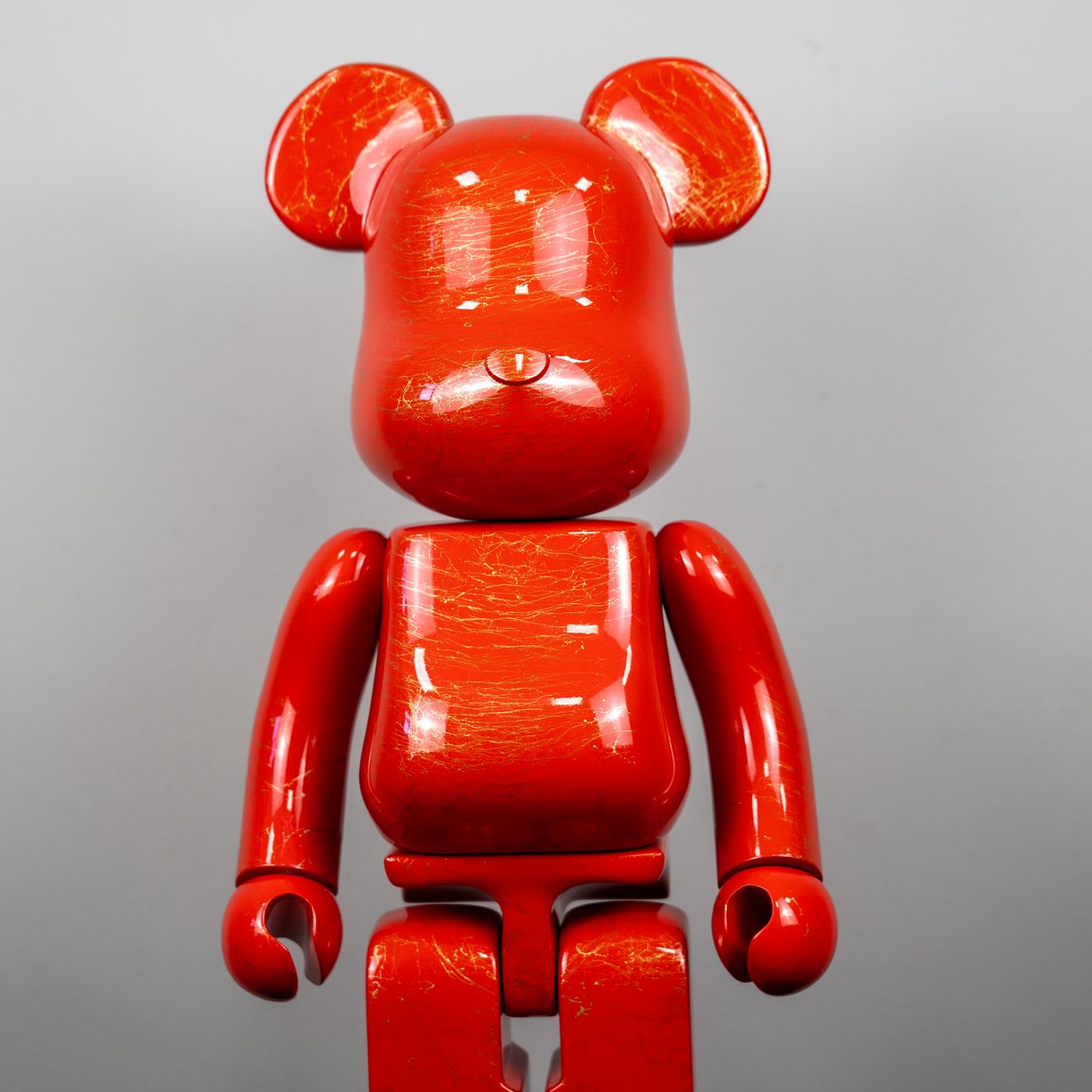
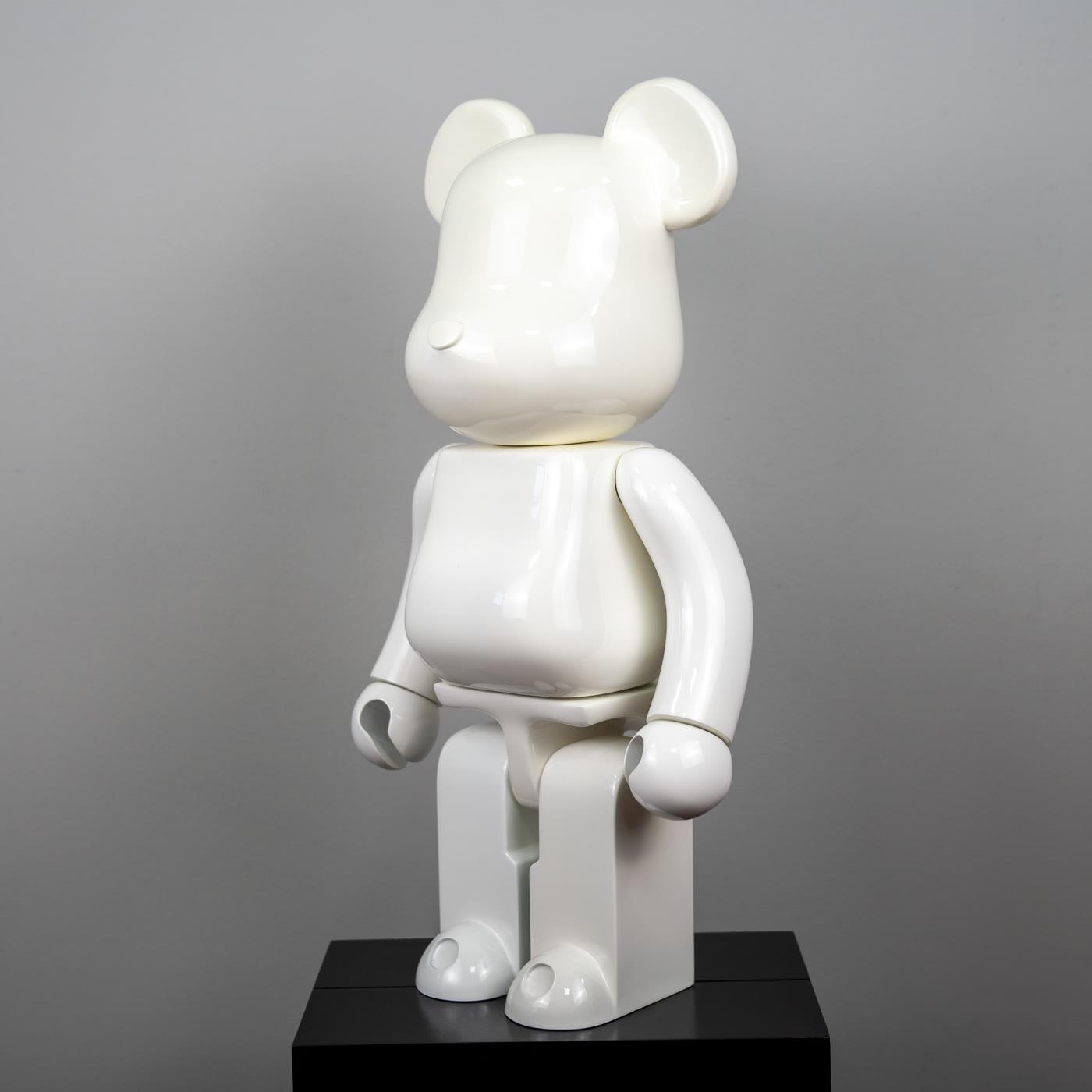
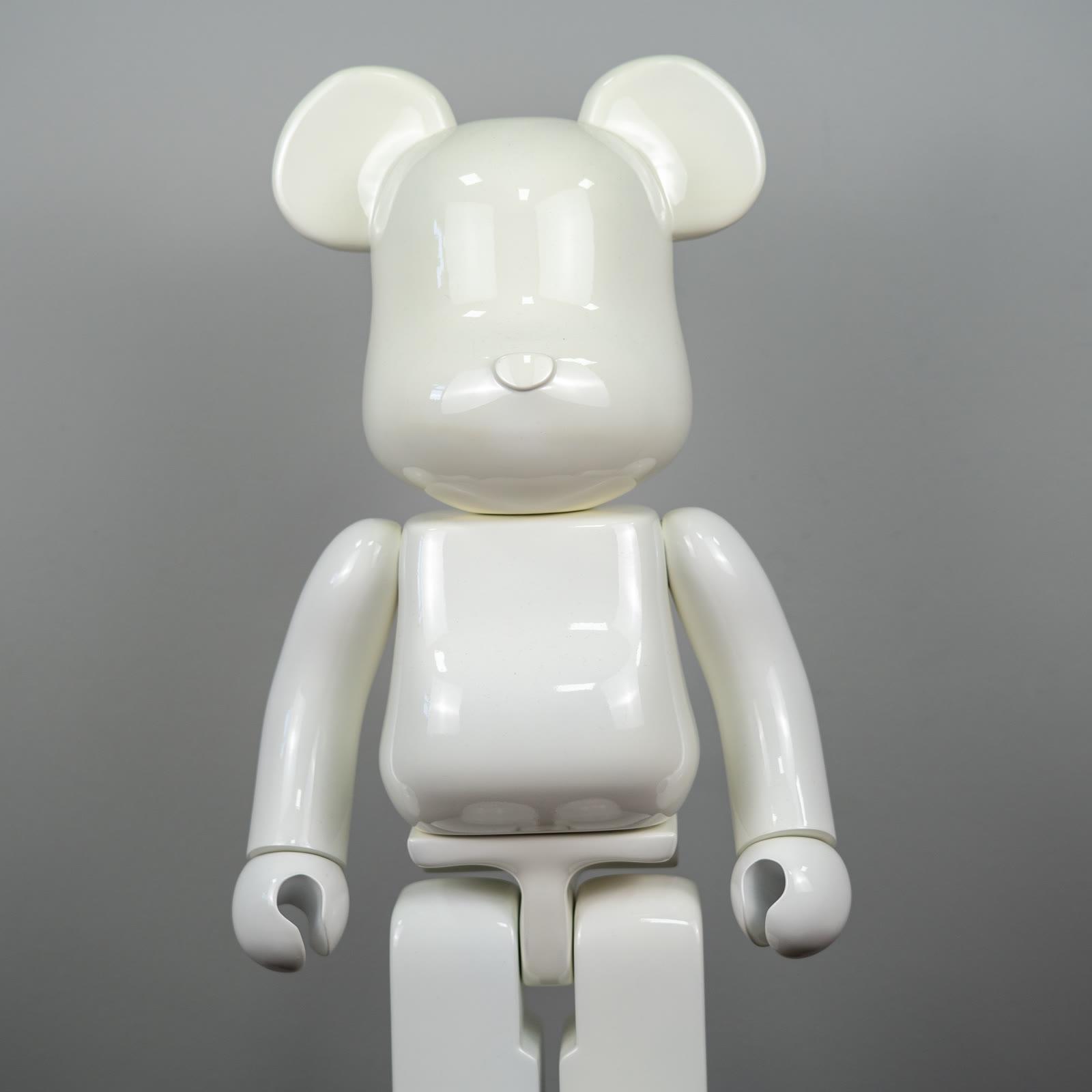
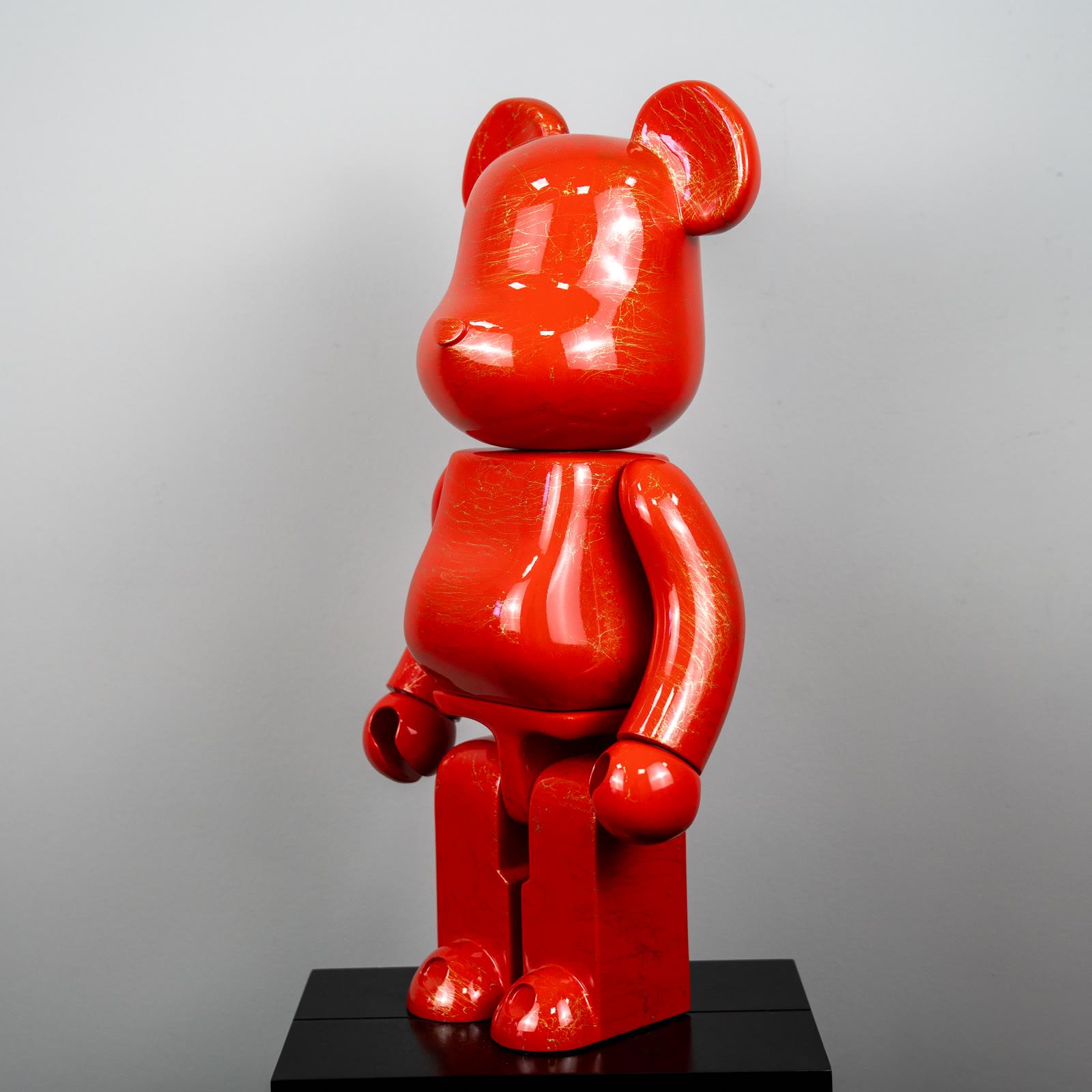
Other percentages exist in the system. Their millimetres are not written here. The current chart is what counts. Popüler Sanat photographs are not read as one of these three heights. The glossy red bear figure with gold marble pattern is an example of color and finish. So is the glossy white bear figure. Neither image is evidence of 400% or 1000%.
What makes the comparison useful is how each height behaves in a room. Seven centimetres keeps company. Twenty-eight stands and is seen. Seventy takes floor and affects how people move. The size system holds where the numbers come from. This piece holds the difference of living beside them.
What does 100% do at home?
At 70 mm, 100% works at the scale of a desk, the edge of a shelf, and the compartment of a vitrine. It can be turned in the hand. Several of them in a row become a readable line, and the room is not rebuilt around them. This height is at ease where the gaze is already close: a work desk, or the front of a bookcase.
The risk of the small height is disappearance. A lone 70 mm in the middle of a wide console stays like a charm inside the gap around it. In a group, two or three pieces from the same family of finish, it stands more clearly. Light should arrive from nearby too. A distant ceiling spot swallows a surface of 7 cm.
100% is often described as a starting height. Starting does not mean cheap or minor. A close distance makes the joints and the surface decision easier to see. Beginning a collection at this height is a way to learn the form without locking the room. Thinking about a larger percentage afterward reduces the hurry.
How does 400% stand on a shelf?
At 280 mm, 400% stands at shelf and console height. About 28 cm rises above a row of books without taking the place of a cabinet. It is picked out when you enter the door. Come closer and the round of the ears and the block of the arms are still readable. For many homes this is the clearest life of a single figure.
The visual weight of 280 mm depends on color. Glossy red and a gold marble pattern draw attention apart from height. Glossy white stays calmer at the same centimetres. So millimetres are not enough when talking about 400%. Finish shows the mass further forward or further back than it is. The red and white figures in the catalog tell that effect through color. They themselves are not measured as this percentage.
The air you leave on a shelf starts to matter at this height. A hand’s width on each side frees the silhouette from the edge of the furniture. Twenty-eight centimetres stuck to the ceiling on a top shelf looks as if the ears were cut. A console near eye level is the kindest place for 400%. The right scale works that neighborhood more widely.
What does 1000% do to a room?
At 700 mm, 1000% puts a focus in the room. Seventy centimetres, on a low plinth or directly on the floor, comes toward the gaze of someone seated. If it lands in a path, people bump it. If it is squeezed into a corner, the silhouette stays half. This height is thought of like furniture: a place is reserved, circulation is drawn, light is set on purpose.
Visual weight is a little more than the millimetres. If the cylindrical body is dark, the mass feels denser. A glossy surface carrying a highlight along 70 cm can divide the room. 1000% is not a corner ornament. It asks for a decision about one point in the room. The detail of placement is in placing a large bear figure.
The name of this height on Medicom’s chart is not the name of a photograph in the catalog. Seeing a large bear figure does not prove that it is 700 mm. A tape measure proves it. A percentage name is used, inside the manufacturer’s system, only with that system’s own information.
What changes when the three heights stand together?
When the three heights stand together, repetition becomes readable and a hierarchy appears. 70 mm can look like a detail of 280 mm. 700 mm can leave the other two in shadow. That does not have to be a bad result. A deliberate row shows three distances of the same form. An undeliberate row makes the smaller ones forgettable beside the largest.
Using the same color at three heights brings the form forward. Using different colors at three heights sends the eye to the surface instead of the height. At home, one main height is usually enough. If the others stand beside it like guests, the composition does not scatter. The Bearbrick selection shows colors together. Lining them up as if they were three percentages is not this page’s promise.
There is a practical limit to the row as well. Setting a 70 mm piece at the foot of a 700 mm mass can make the small one invisible. Open the distance and both of them breathe. A collection is not a matter of forcing every height onto the same shelf. It is a matter of each height choosing its own horizon.
What is commonly misunderstood about these three numbers?
The first misunderstanding is that the three are a set. Medicom’s system offers a series of heights. A home does not owe all three. A single 280 mm on the right shelf can stand more clearly than a crowded trio. The idea of a set is learned from a vitrine photograph, and it jams when it is carried into a room.
The second is that the large one is the more real version of the small one. 1000% is not more official, more limited, or more correct. It is a height. A logo, a box, or a hologram does not prove that order either. A single mark does not, on its own, show which production a piece comes from.
The third is to derive millimetres for the in-between sizes by leaning on these three. Other percentages exist in the system. Their match is on the current chart. How to read the chart holds that limit separately.
Which height do you start with?
The start is chosen from the centimetres of the gap that will hold it. If the desk is viewed from close, 70 mm is generous enough. If a console faces a room, 280 mm is chosen and still does not break circulation. If the floor is clear, the ceiling is high, and the path is calm, 700 mm is considered. This order is a checklist, not a rule.
Color comes after the height is chosen. A red marble pattern gathers attention even at a small percentage. White may not tire a room even at a large one. These two figures in the catalog stand so that effect can be seen. They are not given one of these three names. Seen beside other masses in the collection, what 7, 28, and 70 centimetres mean grows calmer still.
The last question is plain. Does this gap want a companion of 7 cm, a stance of 28 cm, or a focus of 70 cm? If the answer is given with a tape, the percentage only carries the right name. If the answer is given with the excitement of a screen, all three numbers surprise the room.